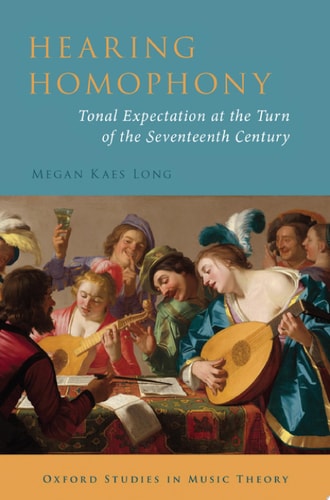
Hearing Homophony: Tonal Expectation at the Turn of the Seventeenth Century
0
0
As an Amazon Associate and affiliate partner, Menrva Books earns from qualifying purchases. Learn more
Author Description
The question of tonality's origins in music's pitch content has long vexed many scholars of music theory. However, tonality is not ultimately defined by pitch alone, but rather by pitch's interaction with elements like rhythm, meter, phrase structure, and form. Hearing Homophony investigates the elusive early history of tonality by examining a constellation of late-Renaissance popular songs which flourished throughout Western Europe at the turn of the seventeenth century. Megan Kaes Long argues that it is in these songs, rather than in more ambitious secular and sacred works, that the foundations of eighteenth century style are found. Arguing that tonality emerges from features of modal counterpoint - in particular, the rhythmic, phrase structural, and formal processes that govern it - and drawing on the arguments of theorists such as Dahlhaus, Powers, and Barnett, she asserts that modality and tonality are different in kind and not mutually exclusive.Using several hundred homophonic partsongs from Italy, Germany, England, and France, Long addresses a historical question of critical importance to music theory, musicology, and music performance. Hearing Homophony presents not only a new model of tonality's origins, but also a more comprehensive understanding of what tonality is, providing novel insight into the challenging world of seventeenth-century music.
Menrva's Summary
THE THESIS
How do the structural elements of late-Renaissance homophonic songs provide the foundational framework for the emergence of eighteenth-century tonality? Megan Kaes Long, a scholar of music theory, synthesizes historical musicology with analytical theory to challenge the traditional focus on complex sacred works. By examining the rhythmic, formal, and phrase-structural processes within popular partsongs, she posits that tonality and modality function as distinct but overlapping systems rather than mutually exclusive categories.
THE SCOPE MAP
What You Will Find
- Analysis of several hundred homophonic partsongs from Italy, Germany, England, and France.
- A theoretical model linking modal counterpoint to the development of tonal expectations.
- Integration of scholarly arguments from theorists including Dahlhaus, Powers, and Barnett.
Scope Limits
- The study focuses primarily on homophonic partsongs rather than large-scale sacred or ambitious secular compositions of the period.
- The analysis is restricted to the transition period at the turn of the seventeenth century.
THE AUTHORITY PERSPECTIVE
Experts recognize this work as a significant contribution to the discourse on the origins of tonality, specifically for its shift in focus toward popular song forms. Readers frequently note the academic density of the prose and the rigorous analytical methodology employed throughout the text.
Page Count:
298
Publication Date:
2020-01-01
Publisher:
Oxford University Press
ISBN-10:
0190851929
ISBN-13:
9780190851927
Music Technology
Academic
Music History
Music theory
Seventeenth Century
Humanities
Musicology
Vocal music
Community Tags
Similar Books