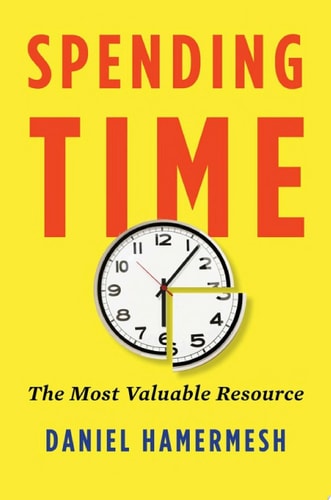
Spending Time: The Most Valuable Resource
0
0
As an Amazon Associate and affiliate partner, Menrva Books earns from qualifying purchases. Learn more
Author Description
Time is the ultimate scarce resource and thus quintessentially a topic for economics, which studies scarcity. Starting with the observation that time is increasingly valuable given competing demands as we have more things we can buy and do, Spending Time provides engaging insights into how people use their time and what determines their decisions about spending their time. That our time is limited by the number of hours in a day, days in a year, and years in our lives means that we face constraints and thus choices that involve trade-offs. We sleep, eat, have fun, watch TV, and not least we work. How much we dedicate to each, and why we do so, is intriguing and no one is better placed to shed light on similarities and differences than Daniel S. Hamermesh, the leading authority on time-use. Here he explores how people use their time, including across countries, regions, cultures, class, and gender.Americans now work more than people in other rich countries, but as recently as the late 1970s they worked no more than others; and they also work longer into older age. Men and women do different things at different times of the day, which affects how well-off they feel. Both the arrival of children and retirement create major shocks to existing time uses, with differences between the sexes. Higher incomes and higher wage rates lead people to hurry more, both on and off the job, and higher wage rates lead people to cut back on activities that take time away from work. Being stressed for time is central to modern life, and Hamermesh shows who is rushed, and why. With Americans working more than people in France, Germany, the U.K., Japan and other rich countries, the book offers a simple but radical proposal for changing Americans' lives and reducing the stress about time.
Menrva's Summary
THE THESIS
This book investigates the economic principles governing how individuals allocate their most finite resource: time. Daniel S. Hamermesh, a prominent labor economist, utilizes extensive time-use data to analyze the trade-offs people make between work, leisure, and domestic responsibilities. He argues that time scarcity is a fundamental economic constraint that dictates human behavior and societal well-being across different cultures and demographics.
THE SCOPE MAP
What You Will Find
- Comparative analysis of time-use patterns across various countries, including the U.S., Germany, France, and Japan.
- Economic frameworks for understanding the impact of wage rates, income levels, and life events like parenthood or retirement on daily schedules.
- Data-driven insights into the phenomenon of time-stress and the gendered division of labor.
Scope Limits
- The text focuses primarily on economic modeling and quantitative data rather than psychological or philosophical explorations of time.
- It does not provide a comprehensive guide for individual time management techniques, focusing instead on macro-level societal trends.
THE AUTHORITY PERSPECTIVE
Experts recognize this work as a foundational text in the field of time-use economics, praised for its rigorous application of economic theory to daily life. Readers frequently note that while the prose is accessible, the book maintains a high level of academic density regarding labor statistics and economic modeling.
Page Count:
232
Publication Date:
2019-01-01
Publisher:
Oxford University Press
ISBN-10:
0190853859
ISBN-13:
9780190853853
Economics
Special Topics
Sociology
Social Science
Time
Community Tags
Similar Books