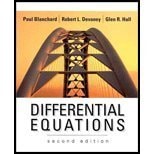
Differential Equations
0
0
As an Amazon Associate and affiliate partner, Menrva Books earns from qualifying purchases. Learn more
Author Description
The authors stress a more balanced approach, one that includes analytic, numeric, and graphical techniques. The book emphasizes modeling and qualitative theory throughout the course. It employs technology significantly and consistently, presents linear and nonlinear systems in parallel, and includes an introduction to discrete dynamical systems. This text grew out of the Boston University Differential Equations Project, funded in part by the National Science Foundation
Menrva's Summary
THE THESIS
This text investigates how a balanced pedagogical approach—integrating analytic, numeric, and graphical techniques—can improve student comprehension of differential equations. The authors, representing the faculty at Boston University, utilize their experience from the National Science Foundation-funded Differential Equations Project to present a framework that prioritizes modeling and qualitative theory. By emphasizing the parallel study of linear and nonlinear systems, the text provides a comprehensive foundation for understanding complex dynamical behaviors.
THE SCOPE MAP
What You Will Find
- Integration of analytic, numeric, and graphical methods for solving equations
- Application of technology to visualize and solve differential systems
- Parallel analysis of linear and nonlinear mathematical systems
- Introduction to discrete dynamical systems and modeling techniques
THE AUTHORITY PERSPECTIVE
The text is regarded as a standard, rigorous resource for undergraduate mathematics students, noted for its shift away from purely symbolic manipulation toward a more holistic, qualitative understanding. Its emphasis on technology and modeling reflects a modern approach to the subject that remains widely utilized in academic curricula.
Page Count:
816
Publication Date:
2002-01-01
Publisher:
Brooks/Cole Publishing Co.
ISBN-10:
0005377188
ISBN-13:
9780005377185
Science
Calculus
textbook
New Used & Rental Textbooks
Mathematics
Science & Math
Applied
Community Tags
Similar Books