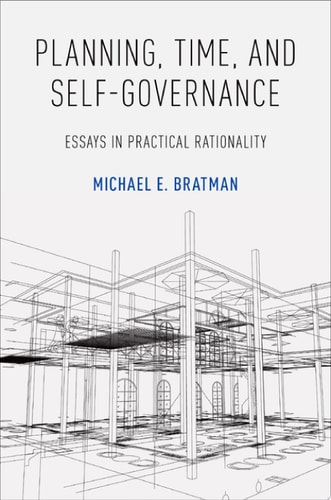
Planning, Time, & Self-Governance: Essays in Practical Rationality
0
0
As an Amazon Associate and affiliate partner, Menrva Books earns from qualifying purchases. Learn more
Author Description
Our human capacity for planning agency plays central roles in the cross-temporal organization of our agency, in our acting and thinking together (both at a time and over time), and in our self-governance (both at a time and over time). Intentions can be understood as states in such a planning system. The practical thinking at the bottom of this planning capacity is guided by norms that enjoin synchronic plan consistency and means-end coherence as well as forms of plan stability over time. The essays in this book aim to deepen our understanding of these norms and to defend their status as norms of practical rationality for planning agents. The general guidance by these planning norms has many pragmatic benefits, especially given our cognitive and epistemic limits. But appeal to these general pragmatic benefits does not fully explain the normative force of these norms in the particular case. In response to this challenge some think these norms are, at bottom, norms of theoretical rationality on one's beliefs; some think these norms are constitutive of intentional agency; some think they are norms of interpretation; and some think the idea of such norms of practical rationality is a myth. These essays chart an alternative path. This path sees these planning norms as tracking conditions of a planning agent's self-governance, both at a time and over time. It seeks associated models of such self-governance. And it appeals to the idea that the end of one's self-governance over time, while not essential to intentional agency per se, is, within the planning framework, rationally self-sustaining and a keystone of a rationally stable reflective equilibrium that involves the norms of plan rationality. This end is thereby in a position to play a role in our planning framework that parallels the role of a concern with quality of will within the framework of the reactive emotions, as understood by Peter Strawson.
Menrva's Summary
THE THESIS
This collection of essays investigates the normative foundations of planning agency and how these norms function as requirements of practical rationality. Michael Bratman, a prominent philosopher of action, utilizes his established framework of planning agency to argue that norms of consistency and coherence are not merely pragmatic tools but are deeply linked to the structure of self-governance. He addresses the challenge of explaining the normative force of these requirements by proposing that they track the conditions necessary for an agent to maintain self-governance over time.
THE SCOPE MAP
What You Will Find
- A detailed analysis of synchronic plan consistency and means-end coherence.
- Theoretical exploration of how intentions function within a planning system.
- Philosophical arguments regarding the relationship between self-governance and reflective equilibrium.
- Comparisons to Peter Strawson's framework of reactive emotions.
Scope Limits
- The text does not provide a general introduction to philosophy of action for lay readers.
- It does not offer empirical psychological data or clinical studies on executive function.
THE AUTHORITY PERSPECTIVE
Experts in the philosophy of action recognize this work as a significant contribution to the ongoing debate regarding the nature of practical reason. Readers frequently note the high level of academic density and the rigorous, technical nature of the prose, which is intended for an audience of professional philosophers and advanced students.
Page Count:
288
Publication Date:
2018-01-01
Publisher:
Oxford University Press
ISBN-10:
0190867884
ISBN-13:
9780190867881
Philosophy
Ethics
Practical Rationality
Mind & Body
Agency
Community Tags
Similar Books