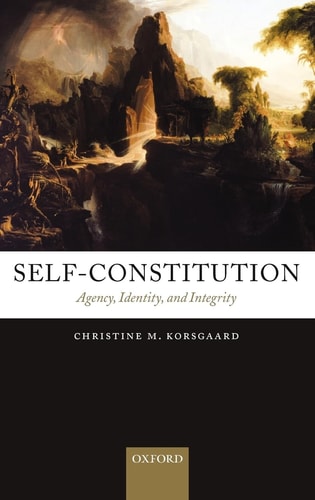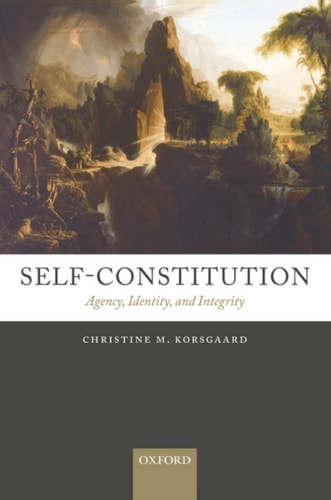
Self-Constitution: Agency, Identity, and Integrity
0
0
As an Amazon Associate and affiliate partner, Menrva Books earns from qualifying purchases. Learn more
Author Description
Christine M. Korsgaard presents an account of the foundation of practical reason and moral obligation. Moral philosophy aspires to understand the fact that human actions, unlike the actions of the other animals, can be morally good or bad, right or wrong. Few moral philosophers, however, have exploited the idea that actions might be morally good or bad in virtue of being good or bad of their kind - good or bad as actions. Just as we need to know that it is the function of the heart to pump blood to know that a good heart is one that pumps blood successfully, so we need to know what the function of an action is in order to know what counts as a good or bad action. Drawing on the work of Plato, Aristotle, and Kant, Korsgaard proposes that the function of an action is to constitute the agency and therefore the identity of the person who does it. As rational beings, we are aware of, and therefore in control of, the principles that govern our actions. A good action is one that constitutes its agent as the autonomous and efficacious cause of her own movements. These properties correspond, respectively, to Kant's two imperatives of practical reason. Conformity to the categorical imperative renders us autonomous, and conformity to the hypothetical imperative renders us efficacious. And in determining what effects we will have in the world, we are at the same time determining our own identities. Korsgaard develops a theory of action and of interaction, and of the form interaction must take if we are to have the integrity that, she argues, is essential for agency. On the basis of that theory, she argues that only morally good action can serve the function of action, which is self-constitution.
Menrva's Summary
THE THESIS
This book investigates the foundational question of how human actions can be evaluated as morally good or bad by defining the function of action as the self-constitution of the agent. Christine M. Korsgaard, a prominent philosopher specializing in Kantian ethics, synthesizes classical and modern perspectives to argue that moral obligation arises from the necessity of maintaining agency. By drawing on the teleological frameworks of Plato and Aristotle alongside Kantian practical reason, she posits that an action's success is measured by its ability to constitute the agent as an autonomous and efficacious cause.
THE SCOPE MAP
What You Will Find
- A teleological account of human action based on the function of the agent.
- An analysis of Kant's categorical and hypothetical imperatives as tools for self-constitution.
- A theoretical framework linking personal identity to the consistency of one's actions.
- Philosophical arguments regarding the necessity of integrity for effective agency.
Scope Limits
- The text does not provide a comprehensive history of moral philosophy beyond the specific influences of Plato, Aristotle, and Kant.
- The work focuses primarily on the internal mechanics of agency rather than applied ethics or political policy.
THE AUTHORITY PERSPECTIVE
Experts recognize this work as a significant contribution to contemporary moral philosophy, particularly for its rigorous defense of Kantian constructivism. Readers frequently note the academic density of the prose, which requires a strong background in ethical theory to fully grasp the author's complex arguments.
Page Count:
240
Publication Date:
2009-01-01
Publisher:
Oxford University Press
ISBN-10:
0191567825
ISBN-13:
9780191567827
Philosophy
Practical reason
Ethics
Act Philosophy
Reason
Responsibility
Identity
Moral Philosophy
Agency