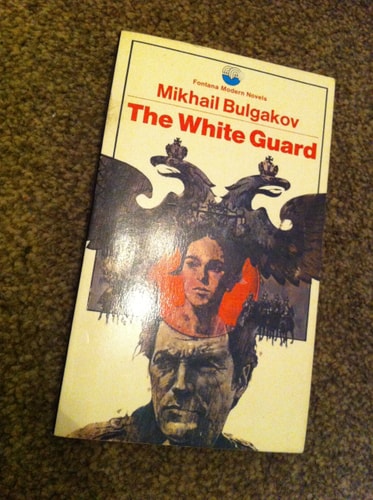
The White Guard
0
0
As an Amazon Associate and affiliate partner, Menrva Books earns from qualifying purchases. Learn more
Author Description
Bulgakov's elegant first novel about the unfolding of the October revolution in Kiev--referred to as The City in the novel--has been rereleased by independent publisher Melville House this year, in the Michael Glenny translation. Told through multiple points of view, the book centers upon two days in the Russian Civil war, December 13 and 14, 1918, when the city of Kiev, up to then controlled by the Ukrainian Hetman Skoropadsky, a German puppet and ally of the Monarchist Russians, falls to the armies of Petlyura, a Ukranian peasant nationalist, a figure of mystery and rumor. The enemy of the Whites, Petlyura's troops especially target the Russian officers who have supported the corrupt Skoropadsky and the Russian imperialist presence.The heart of the novel is the family of the Turbins, Alexei, a doctor returning from WWI, his little brother Nikolai, 17 and a cadet at the Russian military academy, and their sister Elena, the muse of a circle of Alexei's officer friends, as well as the Turbin's comic foil, Vasily Lisovich, known as Vasilisa (after the folk heroine Vasilisa the Beautiful) an almost Doestoyevskian idiot who is the Turbin's downstairs neighbor.Admirably told, the novel reveals the hand of Bulgakov the dramatist as well as that of the prose artist, and aspects such as the dreams and Alexei Turbin's delirium in a fever from typhus very much herald the arrival of the surrealistic Master and Margarita.The White Guard beautifully portrays the chaos of a civil war, and meditates on themes of family loyalty and friendship.The prose work was published in 1925 as a magazine serial, but the magazine folded before the serial was complete. Stalin was said to have seen the play many times, it probably saved Bulgakov's life. The Master and Margarita was far more politically questionable and never saw the light of day in Bulgakov's lifetime. The popular play based on this story ran in Soviet Russia from 1926 to 1941--but the book did not appear until 1966.
Menrva's Summary
THE PULSE
As the Russian Civil War descends upon Kiev in 1918, the Turbin family struggles to maintain their domestic stability amidst the violent collapse of the old imperial order. Alexei, a doctor recently returned from the front, finds himself and his siblings, Elena and Nikolai, caught in the crossfire between retreating German forces, the puppet government of Hetman Skoropadsky, and the encroaching peasant army of Petlyura. The narrative shifts between the intimate, claustrophobic confines of the Turbin household and the chaotic, shifting front lines of the city. Through a multi-perspective lens, the story captures the disintegration of social structures and the personal toll of ideological upheaval on those who simply wish to survive the winter.
INSIDE THE PAGES
- Multi-perspective narrative structure capturing the chaos of urban warfare
- Vivid depiction of the 1918 Kiev occupation and the fall of the Hetmanate
- Integration of surrealistic dream sequences and fever-induced delirium
- Exploration of the tension between personal loyalty and political allegiance
- Characterization of the Turbin family as a microcosm of the Russian intelligentsia
- Inclusion of satirical elements through the neighbor character Vasily Lisovich
- Stylistic influence of the author's background as a dramatist and prose artist
- Examination of the psychological impact of war on military officers and civilians
THE COLLECTIVE ECHO
Bulgakov’s work is widely regarded as a seminal exploration of the Russian Civil War, noted for its ability to balance historical gravity with intimate human drama. Critics frequently highlight the novel's foreshadowing of the author's later, more surrealistic masterpieces, particularly in its use of dreamscapes and psychological depth. The text is often praised for its refusal to simplify the complex loyalties of the era, instead focusing on the preservation of culture and family in the face of total societal collapse. Readers and scholars alike recognize the book as a vital piece of 20th-century literature that survived intense political scrutiny to offer a profound look at a city in transition.
Page Count:
288
Publication Date:
1998-01-01
Publisher:
Fontana Books
ISBN-10:
0006131530
ISBN-13:
9780006131533
Historical Fiction
classic
Civil War
Genre Fiction
Russian
War
Political fiction
Literature & Fiction
Community Tags
Other Editions(2)

Similar Books





Reader Comments
Share Your Thoughts
No comments yet. Be the first to share your thoughts!