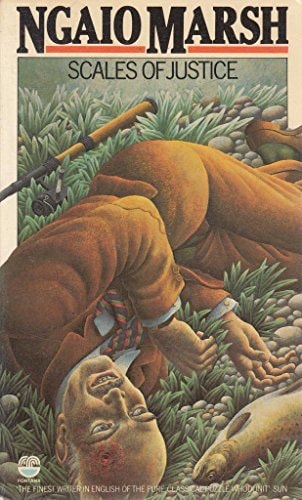
Scales of Justice
0
0
As an Amazon Associate and affiliate partner, Menrva Books earns from qualifying purchases. Learn more
Author Description
Of all the books in the Alleyn series, Scales of Justice is most powerfully reminiscent of Agatha Christie, with its setting in an almost unspeakably charming little English village, and its cast of inbred aristocrats. When one of the aristos turns up dead next to the local trout-stream – with, in fact, a trout at his side – everyone is dreadfully upset, of course, but really, just a tad irritated as well: Murder is so awfully messy. Thank gawd that nice Inspector Alleyn – not really one of us, you know, but not terribly wide of the mark – is on hand to clear things up. Though one could wish that he didn’t feel compelled to ask quite so many questions.
Menrva's Summary
THE PULSE
When a local aristocrat is discovered dead beside a trout stream, Inspector Roderick Alleyn must navigate the insular and dismissive social circles of a charming English village to identify a killer. The investigation forces Alleyn to contend with a cast of characters who view the murder more as a social inconvenience than a tragedy. As he attempts to extract the truth from the tight-lipped residents, he faces the logical challenge of untangling a web of long-standing local grievances and hidden motives. The narrative follows a traditional third-person perspective, emphasizing the methodical collection of clues and the psychological profiling of the suspects.
INSIDE THE PAGES
- Traditional English village setting
- Aristocratic social dynamics
- Methodical police procedural elements
- Focus on class-based social friction
- Red herrings and subtle misdirection
- Sharp, observational dialogue
- Emphasis on motive over physical action
- Intellectual puzzle-solving structure
THE COLLECTIVE ECHO
This work is frequently noted for its stylistic proximity to the golden age of detective fiction, particularly the works of Agatha Christie. The narrative relies on the interplay between the polished, observant Inspector Alleyn and the rigid, often oblivious social hierarchy of the village. Readers often highlight the author's ability to balance a grim crime with the detached, almost comedic irritation of the suspects involved. The book serves as a quintessential example of the classic whodunit, where the atmosphere of the setting is as vital to the mystery as the evidence itself.
Page Count:
254
Publication Date:
1955-01-01
Publisher:
Fontana
ISBN-10:
0006143849
ISBN-13:
9780006143840
Mystery
Crime
Crime & mystery
Mystery fiction
Investigation
Police
Fiction
Classic Crime
Detective
Traditional Detectives
Classic fiction
British literature
Murder
Open library staff picks
Mystery Thriller & Suspense
England
Roderick Alleyn Fictitious character
Alleyn Roderick Fictitious character
Community Tags
Other Editions(12)







Similar Books



Reader Comments
Share Your Thoughts
No comments yet. Be the first to share your thoughts!