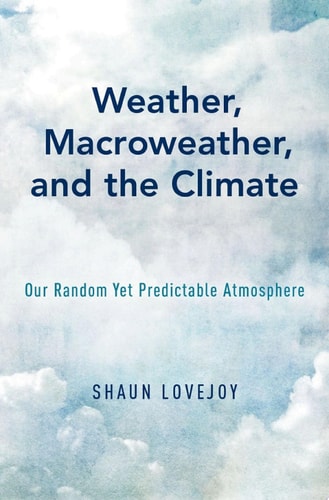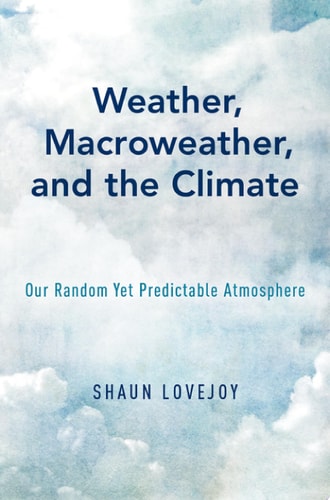
Weather, Macroweather, and the Climate
0
0
As an Amazon Associate and affiliate partner, Menrva Books earns from qualifying purchases. Learn more
Author Description
Weather, Macroweather, And The Climate Is An Insider's Attempt To Explain As Simply As Possible How To Understand The Atmospheric Variability That Occurs Over An Astonishing Range Of Scales: From Millimeters To The Size Of The Planet, From Milliseconds To Billions Of Years. The Variability Is So Large That Standard Ways Of Dealing With It Are Utterly Inadequate: In 2015, It Was Found That Classical Approaches Had Underestimated The Variability By The Astronomical Factor Of A Quadrillion (a Million Billion). Author Shaun Lovejoy Asks - And Answers - Many Fundamental Questions Such As: Is The Atmosphere Random Or Deterministic? What Is Turbulence? How Big Is A Cloud (what Is The Appropriate Notion Of Size Itself)? What Is Its Dimension? How Can We Conceptualize The Structures Within Structures Within Structures Spanning Millimeters To Thousands Of Kilometers And Milliseconds To The Age Of The Planet? What Is Weather? What Is Climate? Lovejoy Shows In Simple Terms Why The Industrial Epoch Warming Can't Be Natural - Much Simpler Than Trying To Show That It's Anthropogenic. We Will Discuss In Simple Terms How To Make The Best Seasonal And Annual Forecasts - Without Giant Numerical Models. Above All, The Book Offers Readers A New Understanding Of The Atmosphere.
Menrva's Summary
THE THESIS
This book investigates the fundamental nature of atmospheric variability across vast temporal and spatial scales, challenging the adequacy of classical statistical models. Author Shaun Lovejoy, a professor of physics, utilizes scaling analysis and non-linear dynamics to argue that traditional approaches have drastically underestimated atmospheric fluctuations. By re-evaluating the definitions of weather and climate through the lens of macroweather, the text provides a framework for understanding climate change that bypasses the need for complex numerical simulations.
THE SCOPE MAP
What You Will Find
- Scaling laws applied to atmospheric phenomena from millimeters to planetary sizes.
- A distinction between weather, macroweather, and climate based on statistical variability.
- Methodologies for seasonal and annual forecasting without reliance on giant numerical models.
- Evidence regarding the non-natural origins of industrial-era warming.
Scope Limits
- The text does not provide a comprehensive history of meteorological instrumentation.
- It does not focus on the political or policy-based aspects of climate change mitigation.
THE AUTHORITY PERSPECTIVE
Experts recognize this work as a significant contribution to the field of atmospheric physics, particularly for its focus on scaling and variability. Readers frequently note the technical density of the prose, which requires a foundational understanding of physics to fully grasp the author's arguments.
Page Count:
304
Publication Date:
2019-01-01
Publisher:
Oxford University Press
ISBN-10:
0190864222
ISBN-13:
9780190864224
Science
Meteorology
Atmospheric Science
Climatology
Physics
Community Tags
Similar Books