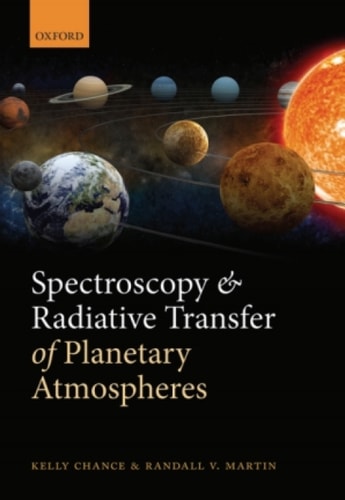
Spectroscopy and Radiative Transfer of Planetary Atmospheres
0
0
As an Amazon Associate and affiliate partner, Menrva Books earns from qualifying purchases. Learn more
Author Description
Spectroscopy and radiative transfer are rapidly growing fields within atmospheric and planetary science with implications for weather, climate, biogeochemical cycles, air quality on Earth, as well as the physics and evolution of planetary atmospheres in our solar system and beyond. Remote sensing and modeling atmospheric composition of the Earth, of other planets in our solar system, or of planets orbiting other stars require detailed knowledge of how radiation and matter interact in planetary atmospheres. This includes knowledge of how stellar or thermal radiation propagates through atmospheres, how that propagation affects radiative forcing of climate, how atmospheric pollutants and greenhouse gases produce unique spectroscopic signatures, how the properties of atmospheres may be quantitatively measured, and how those measurements relate to physical properties. This book provides this fundamental knowledge to a depth that will leave a student with the background to become capable of performing quantitative research on atmospheres. The book is intended for graduate students or for advanced undergraduates. It spans across principles through applications, with sufficient background for students without prior experience in either spectroscopy or radiative transfer. Courses based on this book are intended to be accompanied by the development of increasing sophisticated atmospheric and spectroscopic modeling capability (ideally, the student develops a computer model for simulation of atmospheric spectra from microwave through ultraviolet).
Menrva's Summary
THE THESIS
This text investigates the fundamental physical principles governing the interaction between radiation and matter within planetary atmospheres to enable quantitative atmospheric research. Authors Kelly Chance and Randall V. Martin provide a comprehensive framework that bridges basic theory with practical application, specifically designed for graduate-level study. The book synthesizes the physics of radiative propagation with the spectroscopic signatures of atmospheric constituents to address climate forcing, air quality, and planetary evolution.
THE SCOPE MAP
What You Will Find
- Principles of radiative transfer and atmospheric spectroscopy
- Methodologies for modeling atmospheric composition and spectra
- Analysis of radiation propagation from microwave through ultraviolet wavelengths
- Quantitative techniques for relating measurements to physical properties
Scope Limits
- Does not provide a comprehensive history of planetary exploration
- Does not cover general meteorology outside the context of radiative forcing
THE AUTHORITY PERSPECTIVE
Experts identify this work as a rigorous, foundational resource for students entering the fields of atmospheric physics and remote sensing. Readers frequently note the technical density of the material, which requires a strong background in physics and a commitment to developing computational modeling skills.
Page Count:
160
Publication Date:
2017-01-01
Publisher:
OUP Oxford
ISBN-10:
0191638218
ISBN-13:
9780191638213
Science
Spectroscopy
Remote sensing
Earth Sciences
Atmospheric Science
Radiative Transfer
Planetary Science
Physics
Community Tags
Similar Books