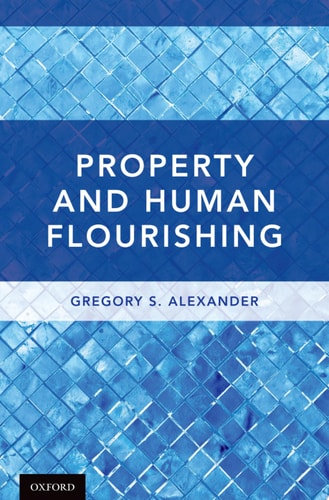
Property and Human Flourishing
0
0
As an Amazon Associate and affiliate partner, Menrva Books earns from qualifying purchases. Learn more
Author Description
Many people assume that what morally justifies private ownership of property is either individual freedom or social welfare, defined in terms of maximizing personal preference-satisfaction. This book offers an alternative way of understanding the moral underpinning of private ownership of property.Rather than identifying any single moral value, this book argues that human flourishing, understood as morally pluralistic and objective, is property's moral foundation. The book goes on to develop a theory that connects ownership and human flourishing with obligations. Owners have obligations to members of the communities that enabled the owners to live flourishing lives by cultivating in their community members certain capabilities that are essential to leading a well-lived life. These obligations are rooted in the interdependence that exists between owners and their community members, and inherent in the human condition.Obligations have always been inherent in ownership. Owners are not free to inflict nuisances upon their neighbors, for example, by operating piggeries in residential neighborhoods. The human flourishing theory explains why owners at times have obligations that enable their fellow community members to develop certain necessary capabilities, such as health care and security. This is why, for example, farm owners may be required to allow providers of health care and legal assistance to enter their property to assist employees who are migrant workers.Moving from the abstract and theoretical to the practical, this book considers implications for a wide variety of property issues of importance both in the literature and in modern society. These include questions such as: When is a government's expropriation of property legitimated for the reason it is for public use? May the owner of a historic or architecturally significant house destroy it without restriction? Do institutions that owned African slaves or otherwise profited from the slave trade owe any obliga
Menrva's Summary
THE THESIS
This book investigates whether human flourishing, rather than individual freedom or social welfare, serves as the primary moral foundation for private property ownership. Gregory S. Alexander, a legal scholar, challenges traditional justifications for property rights by proposing a pluralistic, objective framework. He argues that ownership is inherently tied to social obligations, asserting that property holders have a moral duty to support the capabilities of community members who enable their own flourishing.
THE SCOPE MAP
What You Will Find
- A theoretical framework connecting property rights to human capabilities and community interdependence.
- Analysis of historical and contemporary property disputes, including expropriation and historic preservation.
- Ethical arguments regarding the obligations of institutions linked to historical injustices like the slave trade.
Scope Limits
- The text does not provide a comprehensive legal manual for property litigation.
- It does not offer an exhaustive historical account of property law evolution across all global jurisdictions.
THE AUTHORITY PERSPECTIVE
Legal scholars and ethicists recognize this work as a significant contribution to the discourse on property theory and social obligation. Readers frequently note the academic density of the prose, which is intended for an audience familiar with legal philosophy and political theory.
Page Count:
392
Publication Date:
2018-03-26
Publisher:
Oxford University Press
ISBN-10:
019086074X
ISBN-13:
9780190860745
Philosophy
Social Theory
Law
Property Law
Ethics
Property
Community Tags
Other Editions(2)
Similar Books

Reader Comments
Share Your Thoughts
No comments yet. Be the first to share your thoughts!