The Neal Pollack Anthology Of American Literature
0
0
As an Amazon Associate and affiliate partner, Menrva Books earns from qualifying purchases. Learn more
Author Description
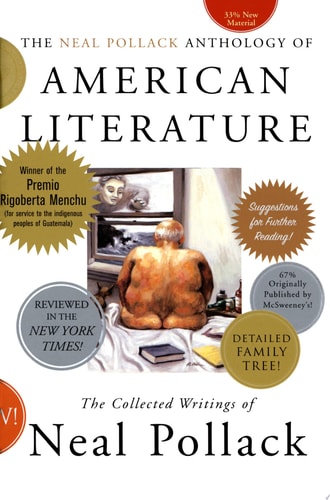
Neal Pollack has been the Greatest Living American Writer across six decades, seven continents, and ten wives. He has won the Pulitzer Prize, the Booker Prize, the PEN/Faulkner Award (twice), and the Premio Simon Bolivar for contributions to the people's struggle in Latin America. In 1985, Pollack's writing was declared "beyond our meager standards" by the Swedish Academy. With the publication of The Neal Pollack Anthology of American Literature, the definitive collection of his work in English, a new generation of readers is set to discover nothing less than the ultimate meaning of human existence on earth. This astonishing work of fictitious nonfiction, the funniest and most creatively styled postmodernist confection of its time, has been universally praised as the best book ever written except for maybe Don Quixote and The Shipping News. The Anthology -- now expanded, updated, and thoroughly repaginated -- answers, once and for all, the question that has plagued American society in general, and literary critics in particular, since Neal Pollack was born: "Who is Neal Pollack?" At last, we know.
Menrva's Summary
THE PULSE
The central conflict involves the protagonist's desperate attempt to establish his own legend as the greatest writer in history through a series of increasingly absurd and self-aggrandizing literary claims. Pollack navigates a world of his own invention, where he occupies the roles of Pulitzer winner, global adventurer, and cultural icon. He faces the opposition of a reality that refuses to acknowledge his self-proclaimed status, forcing him to construct a narrative framework that blends autobiography with blatant fabrication. The text operates as a non-linear collection of essays, each designed to reinforce his persona while mocking the conventions of the literary establishment. His objective remains the total dominance of the American literary consciousness through sheer force of ego.
INSIDE THE PAGES
- Satirical deconstruction of literary awards and accolades
- Unreliable first-person narration
- Absurdist biographical claims
- Meta-fictional commentary on the publishing industry
- Stylistic mimicry of high-brow literary criticism
- Episodic structure covering various facets of the author's invented life
- Hyperbolic characterization of the author as a cultural figure
- Irony-laden prose that challenges the reader's perception of truth
THE COLLECTIVE ECHO
Readers frequently highlight the book's commitment to its own absurdity, noting that the humor relies heavily on the reader's familiarity with literary tropes. Discussion often centers on the effectiveness of Pollack's persona as a vehicle for mocking the pretension found in contemporary writing circles. Critics observe that the pacing is intentionally uneven, mirroring the chaotic nature of the author's fictionalized life. The balance of the work leans heavily toward character-driven satire rather than traditional plot progression, which serves to emphasize the central theme of ego-driven mythmaking. Many find the stylistic choices to be a sharp critique of the cult of personality in modern media.
Page Count:
0
Publication Date:
1900-01-01
ISBN-10:
0060045337
ISBN-13:
9780060045333
Humor
Satire
Parody
Essays
Postmodern Fiction
Community Tags
Similar Books