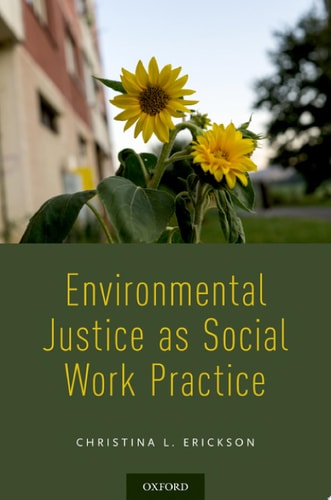
Environmental Justice as Social Work Practice
0
0
As an Amazon Associate and affiliate partner, Menrva Books earns from qualifying purchases. Learn more
Author Description
Environmental Justice as Social Work Practice places the natural environment as central to practice. Utilizing the Phases of Practice and micro to macro levels of practice, the book integrates neatly into a college semester course. Chapters cover important components of social work such as theory, ethics, conceptual foundations as well as distinct chapters on micro, mezzo, and macro practice. Each chapter expands the discipline's commitment to and applied efforts in the environmental movement while recognizing the unique contributions social work has to offer to ameliorate environmental inequities. Chapters include real-world stories from environmental social work practitioners, case studies, and boxed sections highlighting organizations and people who bridge the human and natural justice divide. Each chapter concludes with learning activities and critical thinking questions providing learning activities that map easily to a course syllabus. A matrix identifying the placement of educational competencies from the Council on Social Work Education is included. The textbook provides a framework for social work educators to bravely and competently teach environmental social work as a stand-alone college course or to incorporate into a traditional practice course.
Menrva's Summary
THE THESIS
This text investigates how the natural environment can be integrated as a central component of social work practice to address systemic environmental inequities. Christina L. Erickson, a scholar in the field, provides a structured framework that aligns environmental advocacy with established social work methodologies. By utilizing the Phases of Practice and examining micro, mezzo, and macro levels of intervention, the author argues that social workers possess unique tools to bridge the gap between human welfare and ecological health.
THE SCOPE MAP
What You Will Find
- Theoretical foundations and ethical frameworks for environmental social work
- Application of micro, mezzo, and macro practice levels to environmental issues
- A matrix mapping content to Council on Social Work Education (CSWE) competencies
- Learning activities and critical thinking questions for classroom use
Scope Limits
- The text focuses specifically on the social work profession and may not cover broader environmental science or policy technicalities in depth
- It is designed primarily as a pedagogical tool for educators rather than a general interest guide
THE AUTHORITY PERSPECTIVE
Educators and practitioners frequently identify this book as a foundational resource for integrating environmental justice into social work curricula. Experts highlight the text's practical utility, noting that its structured approach to competencies makes it highly effective for both stand-alone courses and as a supplement to traditional practice training.
Page Count:
216
Publication Date:
2018-07-02
Publisher:
Oxford University Press
ISBN-10:
0190871059
ISBN-13:
9780190871055
Social Work
Social service
Introduction to Social WorkWelfare
Professional Practice
Education
Sociology
Community Tags
Other Editions(3)

Similar Books