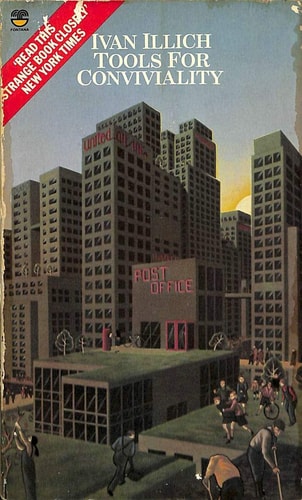
Tools for Conviviality
0
0
As an Amazon Associate and affiliate partner, Menrva Books earns from qualifying purchases. Learn more
Author Description
Tools for Conviviality is a 1973 book by Ivan Illich about the proper use of technology. It was published only two years after his previous book Deschooling Society. In this new work Illich generalized the themes that he had previously applied to the field of education: the institutionalization of specialized knowledge, the dominant role of technocratic elites in industrial society, and the need to develop new instruments for the reconquest of practical knowledge by the average citizen. He wrote that "[e]lite professional groups … have come to exert a 'radical monopoly' on such basic human activities as health, agriculture, home-building, and learning, leading to a 'war on subsistence' that robs peasant societies of their vital skills and know-how. The result of much economic development is very often not human flourishing but 'modernized poverty', dependency, and an out-of-control system in which the humans become worn-down mechanical parts." Illich proposed that we should "invert the present deep structure of tools" in order to "give people tools that guarantee their right to work with independent efficiency." The idea of the 'radical monopoly' is also applied to the effects of cars on the urban form, as "speedy vehicles of all kinds render space scarce." Ivan Illich contributes to a radical critique of modern urbanism: "this monopoly over land turns space into car fodder. It destroys the environment for feet and bicycles. Even if planes and buses could run as nonpolluting, nondepleting public services, their inhuman velocities would degrade man’s innate mobility and force him to spend more time for the sake of travel." Tools for Conviviality attracted worldwide attention. A résumé of it was published by French social philosopher André Gorz in Les Temps Modernes, under the title "Freeing the Future". The book’s vision of tools that would be developed and maintained by a community of users had a significant influence on the first developers of the persona
Menrva's Summary
THE THESIS
How can society invert the current industrial structure to reclaim human autonomy from the dominance of technocratic systems? Ivan Illich, a social critic and former priest, utilizes his background in institutional analysis to argue that modern industrial tools have created a 'radical monopoly' over essential human activities. He posits that professional elites have institutionalized knowledge to the point of creating 'modernized poverty,' and he proposes a framework for 'convivial' tools that empower individuals to act with independent efficiency rather than serving as components in a mechanical system.
THE SCOPE MAP
What You Will Find
- Analysis of the 'radical monopoly' exerted by professional elites over health, education, and housing.
- Critique of modern urbanism and the impact of high-speed transportation on human mobility and space.
- Theoretical framework for 'convivial' tools that support autonomous, community-based production.
- Examination of the relationship between economic development and the erosion of vital subsistence skills.
THE AUTHORITY PERSPECTIVE
This work is regarded as a foundational text in the critique of industrial society and the philosophy of technology. Its influence extends across diverse fields, from the development of personal computing to contemporary movements in sustainable urban design and social ecology.
Page Count:
128
Publication Date:
1973-01-01
Publisher:
Fontana Collins
ISBN-10:
0006336213
ISBN-13:
9780006336211
Economics
Philosophy
Politics
Sociology
urban planning
Counseling Psychology
Technology
Industry
Community Tags
Other Editions(4)


Similar Books













Reader Comments
Share Your Thoughts
No comments yet. Be the first to share your thoughts!