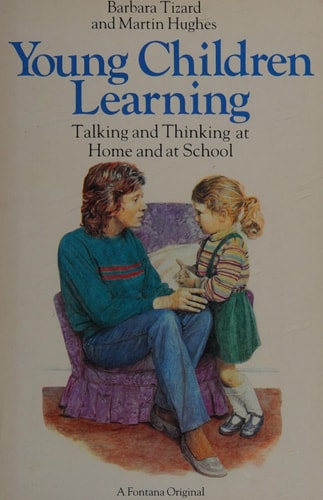
Young Children Learning: Talking and Thinking at Home and at School
0
0
As an Amazon Associate and affiliate partner, Menrva Books earns from qualifying purchases. Learn more
Author Description
Young Children Learning provides vivid insight into the way young children think, talk, and learn from their mothers. It reveals the richness of the home as a learning environment and shows how much children can learn through the ordinary conversations of everyday life.The book describes a research study in which four-year-old girls were tape-recorded talking to their mothers at home and to their teachers at nursery school. At home the children range freely over a wide variety of topics—work, the family, birth, growing up, death. They talk about plans for the future and puzzle over such diverse topics as the shapes of roofs and chairs, the nature of Father Christmas, and whether the queen wears curlers in bed. In many conversations the children are actively struggling to understand a new idea or the meaning of an unfamiliar word. These "passages of intellectual search" show the children to be persistent and logical thinkers.In sharp contrast, the conversations between these same children and their nursery school teachers lack richness, depth, and variety. The questioning, puzzling child is gone: in her place is a child who seems subdued and whose conversations with adults are mainly restricted to answering questions rather than asking them. These observations show how strongly young children can be affected by the move from one setting to another, and they suggest that, even at the nursery stage, children reserve their best thinking for outside the classroom, with a resulting compartmentalization of the knowledge they acquire at school.The book challenges the widely held belief that parents need to learn from professionals how toeducate and bring up their children; above all, it persuades us to value parenting more highly and to have respect for the intellectual capabilities of young minds.
Menrva's Summary
THE THESIS
This study investigates the disparity between the intellectual engagement of four-year-old children in home environments versus nursery school settings. Authors Barbara Tizard and Martin Hughes utilize qualitative data from recorded conversations to challenge the assumption that professional educators are the primary drivers of early childhood cognitive development. Their research highlights the richness of informal domestic interactions and argues that current educational structures may inadvertently stifle the natural curiosity and logical inquiry of young children.
THE SCOPE MAP
What You Will Find
- Comparative analysis of child-mother interactions versus child-teacher interactions.
- Qualitative data derived from tape-recorded conversations of four-year-old girls.
- Examination of 'passages of intellectual search' where children actively grapple with complex concepts.
- Critique of the compartmentalization of knowledge between home and school environments.
THE AUTHORITY PERSPECTIVE
The research presents a compelling, evidence-based challenge to traditional pedagogical hierarchies by elevating the role of the home in cognitive development. The findings suggest a significant need for educators to reconsider how classroom interactions can better foster the intellectual depth children naturally exhibit in their domestic lives.
Page Count:
288
Publication Date:
1984-09-13
Publisher:
Fontana Press
ISBN-10:
0006368239
ISBN-13:
9780006368236
Psychology
Parenting
Education
Sociology
Learning Psychology of
Community Tags
Similar Books