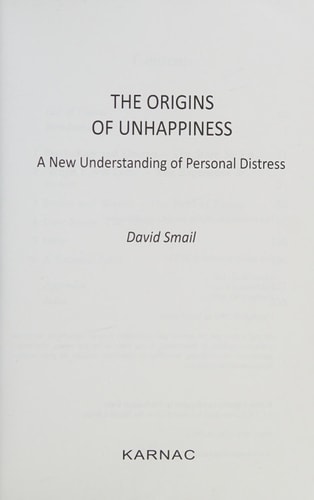
The Origins of Unhappiness: A New Understanding of Personal Distress
0
0
As an Amazon Associate and affiliate partner, Menrva Books earns from qualifying purchases. Learn more
Author Description
It is the main argument of this book that emotional and psychological distress is often brought about through the operation of social-environmental powers which have their origin at a considerable distance from those ultimately subjected to them.On the whole, psychology has concerned itself very little with the field of power which stretches beyond our immediate relations with each other, and this has led to serious limitations on the explanatory power of the theories it has produced. To illustrate this, typical cases of patient distress in the 1980s are examined. The decade when the right-wing of politics proclaimed there was no such thing as society gave rise to psychological distress across social classes, as long-standing societal institutions were dismantled.This is as much a work of sociology, politics, and philosophy, as it is of psychology. Fundamentals of an environmental understanding of distress are outlined. A person is the interaction of a body with the environment. The environment is structured by material power. Power may be coercive, economic, or ideological. Power operates at a varying distance from the person. It is always experienced proximally, but may well originate distally.The operation of power also means the ability of therapy to deal with distress is limited. Therapy essentially consists of three potentially effective elements: provision of comfort; clarification; and encouragement in the use of available powers and resources.
Menrva's Summary
THE THESIS
This work investigates the core question of how distal social and environmental power structures directly precipitate individual psychological distress. Author David Smail, drawing on his clinical background, argues that traditional psychology fails by focusing too narrowly on immediate interpersonal relations. He presents a framework that defines a person as an interaction between a body and a structured environment, asserting that distress is often a rational response to coercive, economic, or ideological forces operating from a distance.
THE SCOPE MAP
What You Will Find
- A theoretical model of environmental psychology that links distal power to proximal distress.
- Analysis of patient case studies from the 1980s to illustrate the impact of societal shifts.
- A critical evaluation of the limitations inherent in traditional therapeutic practices.
- A synthesis of sociological, political, and philosophical perspectives on human suffering.
THE AUTHORITY PERSPECTIVE
The text offers a dense, interdisciplinary critique that challenges the individualistic focus of modern clinical psychology. Its framing suggests a specialized, academic approach intended for readers interested in the intersection of social power and mental health.
Page Count:
288
Publication Date:
1993-01-01
Publisher:
HarperCollins
ISBN-10:
0006377971
ISBN-13:
9780006377979
Psychology
Philosophy
Melancholy
Affective disorders
Emotions
Sadness
Sociology
Mental Health
Community Tags
Similar Books