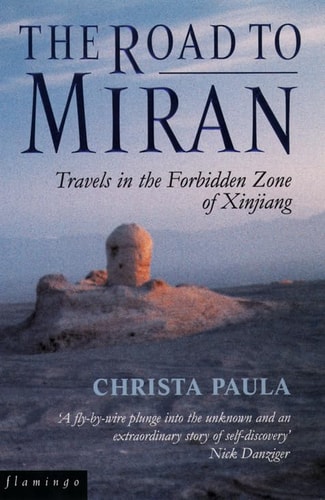
The Road to Miran: Travels in the Forbidden Zone of Xinjiang
0
0
As an Amazon Associate and affiliate partner, Menrva Books earns from qualifying purchases. Learn more
Author Description
Christa Paula, an intrepid young student of Asian art and archaeology, set off in 1989 to explore an area closed to Westerners as well as to most Chinese, and one which is firmly under military rule. Tall and blonde, she travelled for the most part incognito, disguised in a Pathan cap, old grey jacket and big padded trousers. Her goal was Miran, the ancient Buddhist site of second-century wall paintings. In the company of Chang, a maverick taxi driver, Christa Paula travelled through an area dotted with nuclear testing sites, forced labour camps and mines in which prisoners dig and process asbestos without protective clothing. She discovered that villages which exist on maps are now radiation-contaminated ghost towns, and she witnessed everywhere the seeds of discontent and political unrest.
Menrva's Summary
THE THESIS
This work investigates the socio-political and environmental realities of Xinjiang, China, during the late 1980s through the lens of an unauthorized expedition to the ancient Buddhist site of Miran. Christa Paula, a student of Asian art and archaeology, utilizes her 1989 travel experience to document a region largely inaccessible to outsiders. By navigating military-controlled zones and restricted areas, she provides a firsthand account of the intersection between historical preservation and contemporary state-imposed hardship. The narrative serves as a critical examination of the human and ecological costs associated with the region's industrial and military development.
THE SCOPE MAP
What You Will Find
- Detailed observations of the Xinjiang region under strict military oversight in 1989.
- Documentation of environmental degradation, including radiation-contaminated ghost towns.
- Firsthand accounts of labor conditions within asbestos mines and forced labor camps.
- Analysis of the cultural significance of second-century Buddhist wall paintings at Miran.
THE AUTHORITY PERSPECTIVE
The text provides a stark, ground-level perspective on a region that remains historically and politically sensitive. Its value lies in the author's willingness to bypass official channels to document the intersection of ancient history and modern state control.
Page Count:
278
Publication Date:
1995-01-01
Publisher:
Flamingo
ISBN-10:
0006383688
ISBN-13:
9780006383680
History
Travel
Biography
Asia
East
Archaeology
China
Community Tags
Similar Books