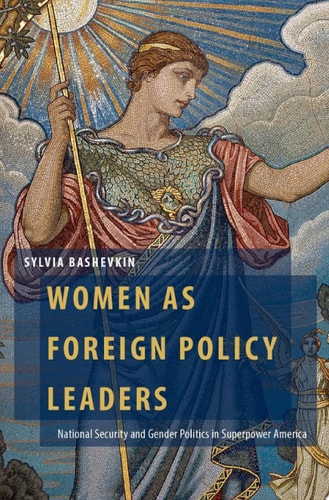
Women as Foreign Policy Leaders: National Security and Gender Politics in Superpower America
0
0
As an Amazon Associate and affiliate partner, Menrva Books earns from qualifying purchases. Learn more
Author Description
What difference does gender make to foreign diplomacy? What do we know about women's participation as decision-makers in international affairs? Is it fair to assume, as many observers do, that female elites will mirror the relatively pacifist preferences of women in the general public as well as the claims of progressive feminist movements? And, of particular importance to this book, what consequences follow from the appointment of "firsts" to these posts? Inspired by recent work in the field of feminist diplomatic history, this book offers the first comparative examination of women's presence in senior national security positions in the United States executive branch. Sylvia Bashevkin looks at four high-profile appointees in the United States since 1980: Jeane Kirkpatrick during the Reagan years, Madeleine Albright in the Clinton era, Condoleezza Rice during the George W. Bush presidency, and Hillary Rodham Clinton in the first Obama mandate. Bashevkin explores the extent to which each of these women was able to fully participate in a domain long dominated by men, focusing in particular on the extent to which each shaped foreign policy in meaningful ways. She looks particularly at two specific phenomena: first, the influence of female decision-makers, notably their ability to make measurable difference to the understanding and practice of national security policy; and second, leaders' actions with respect to matters of war and women's rights. The track records of these four women reveal not just a consistent willingness to pursue muscular, aggressive approaches to international relations, but also widely divergent views about feminism. Women as Foreign Policy Leaders shows how Kirkpatrick, Albright, Rice, and Clinton staked out their presence on the international scene and provided a crucial antidote to the silencing of women's voices in global politics.
Menrva's Summary
THE THESIS
This book investigates whether the presence of women in senior national security positions fundamentally alters the conduct of foreign diplomacy or aligns with the pacifist expectations often attributed to female political elites. Sylvia Bashevkin, a scholar of political science and gender, utilizes a comparative historical framework to analyze the careers of four prominent U.S. female appointees. She argues that these leaders, rather than conforming to stereotypes of pacifism, frequently adopted aggressive, muscular approaches to international relations while maintaining complex and often divergent relationships with feminist ideology.
THE SCOPE MAP
What You Will Find
- Comparative analysis of four U.S. national security appointees: Jeane Kirkpatrick, Madeleine Albright, Condoleezza Rice, and Hillary Rodham Clinton.
- Examination of the executive branch's historical gender dynamics since 1980.
- Evaluation of policy outcomes regarding war, national security, and women's rights.
Scope Limits
- The analysis is restricted to high-profile female appointees within the United States executive branch.
- The study does not provide a comprehensive history of all women in diplomacy, focusing instead on four specific case studies of senior leadership.
THE AUTHORITY PERSPECTIVE
Experts recognize this work as a significant contribution to feminist diplomatic history and the study of gender in executive power. Readers often note the clarity of the comparative methodology, which provides a structured approach to evaluating the impact of individual agency within male-dominated national security institutions.
Page Count:
280
Publication Date:
2018-01-01
Publisher:
Oxford University Press
ISBN-10:
0190875399
ISBN-13:
9780190875398
History
International relations
Comparative Politics
American Government
Gender Studies
National security
United States
Foreign Policy
Community Tags
Similar Books