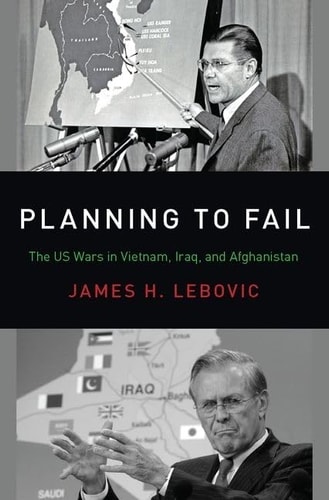
Planning to Fail: The US Wars in Vietnam, Iraq, and Afghanistan
0
0
As an Amazon Associate and affiliate partner, Menrva Books earns from qualifying purchases. Learn more
Author Description
The United States national-security establishment is vast, yet the United States has failed to meet its initial objectives in almost every one of its major, post-World War II conflicts. Of these troubled efforts, the US wars in Vietnam (1965-73), Iraq (2003-11), and Afghanistan (2001-present) stand out for their endurance, resource investment, human cost, and miscalculated decisions. Because overarching policy goals are distant and open to interpretation, policymakers ground their decisions in the immediate world of short-term objectives, salient tasks, policy constraints, and fixed time schedules. As a consequence, they exaggerate the benefits of their preferred policies, ignore the accompanying costs and requirements, and underappreciate the benefits of alternatives.In Planning to Fail, James H. Lebovic argues that a profound myopia helps explain US decision-making failures. In each of the wars explored in this book, he identifies four stages of intervention. First and foremost, policymakers chose unwisely to go to war. After the fighting began, they inadvisably sought to extend or expand the mission. Next, they pursued the mission, in abbreviated form, to suboptimal effect. Finally, they adapted the mission to exit from the conflict.Lebovic argues that US leaders were effectively planning to fail whatever their hopes and thoughts were at the time the intervention began. Decision-makers struggled less than they should have, even when conditions allowed for good choices. Then, when conditions on the ground left them with only bad choices, they struggled furiously and more than could ever matter. Policymakers allowed these wars to sap available capabilities, push US forces to the breaking point, and exhaust public support. They finally settled for terms of departure that they (or their predecessors) would have rejected at the start of these conflicts. Offering a far-ranging and detailed analysis, this book identifies an unmistakable pattern of failure and highlights
Menrva's Summary
THE THESIS
Why does the United States national-security establishment consistently fail to achieve its objectives in major post-World War II conflicts? James H. Lebovic, a professor of political science and international affairs, utilizes historical analysis and decision-making theory to argue that institutional myopia drives these failures. He posits that policymakers prioritize short-term tasks and constraints over long-term strategic goals, leading to a recurring pattern of poor decision-making that persists regardless of the specific conflict.
THE SCOPE MAP
What You Will Find
- Comparative analysis of US military interventions in Vietnam, Iraq, and Afghanistan.
- A four-stage framework of intervention: initial choice, mission expansion, suboptimal pursuit, and exit adaptation.
- Examination of how cognitive biases and organizational pressures influence national security policy.
Scope Limits
- The book does not provide a comprehensive history of the tactical battles within these wars.
- It does not offer a prescriptive manual for future military intervention strategies.
THE AUTHORITY PERSPECTIVE
Experts and political analysts frequently cite this work for its rigorous application of decision-making theory to historical military outcomes. Readers often note the academic density of the prose, which provides a structured and critical look at the systemic failures within the US national-security establishment.
Page Count:
258
Publication Date:
2019-04-11
Publisher:
Oxford University Press
ISBN-10:
0190935324
ISBN-13:
9780190935320
History
Military History
International relations
United States
National security
Community Tags
Similar Books