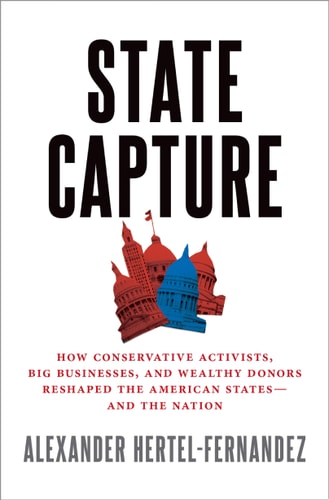
State Capture
0
0
As an Amazon Associate and affiliate partner, Menrva Books earns from qualifying purchases. Learn more
Author Description
Most Americans pay little attention to the massive number of elections that occur at the state level every year. Yet cumulatively, a party's success in state-level races across the country can produce major shifts in policymaking and governance. That is precisely what has happened in the US since 2010. In a wave election that year, the Republican Party began their ascendancy in state-level elections, and by 2016 had solidified their dominance. The party now fully controls 25 state legislatures and governorships-one of the largest advantages either party has had since the New Deal. After the GOP wave, a broad swathe of states began considering and enacting a near-identical set of conservative priorities-often even using the exact same text. Where did this flood of new legislation come from? How did so many states arrive at the same proposals at precisely the same time? As Alexander Hertel-Fernandez shows in the eye-opening State Capture, the answer can be found in a trio of powerful interest groups: the Koch brothers-run Americans for Prosperity (AFP), the American Legislative Exchange Council (ALEC), and the State Policy Network (SPN). Drawing from an impressive evidence base, Hertel-Fernandez explains how, since the 1970s, conservative activists, wealthy donors, and big businesses constructed a right-wing troika of overlapping and influential lobbying groups. But it is about more than this. It also teases out how conservative-corporate mobilization has fostered epochal shifts in the American political economy: the decline of unions, party polarization, and the skyrocketing concentration of wealth. State Capture will be essential reading for anyone interested in understanding contemporary American politics.
Menrva's Summary
THE THESIS
This book investigates how a coordinated network of conservative interest groups successfully captured state-level legislative processes to enact a unified national policy agenda. Alexander Hertel-Fernandez, a political scientist, utilizes extensive archival research, donor records, and legislative tracking data to map the influence of the American Legislative Exchange Council (ALEC), the State Policy Network (SPN), and Americans for Prosperity (AFP). He argues that these organizations created a self-reinforcing infrastructure that allows wealthy donors and corporate interests to bypass traditional democratic deliberation by standardizing legislation across multiple states simultaneously.
THE SCOPE MAP
What You Will Find
- Analysis of the historical development of conservative lobbying networks since the 1970s.
- Examination of the structural mechanisms used to distribute model legislation to state lawmakers.
- Data on the correlation between interest group activity and the decline of labor unions and public sector influence.
Scope Limits
- The analysis focuses primarily on the Republican Party's state-level strategy and does not provide a comparative study of similar organizational structures within the Democratic Party.
- The text prioritizes institutional and structural political analysis over individual biographical profiles of the donors involved.
THE AUTHORITY PERSPECTIVE
Political scientists and policy analysts frequently cite this work as a foundational text for understanding the mechanics of modern state-level lobbying and the professionalization of conservative activism. Readers often note the academic rigor of the prose, which balances detailed empirical evidence with a clear, accessible explanation of complex political systems.
Page Count:
256
Publication Date:
2019-01-01
Publisher:
Oxford University Press
ISBN-10:
019087080X
ISBN-13:
9780190870805
Public Policy
Sociology
American Government
Political History
Community Tags
Similar Books