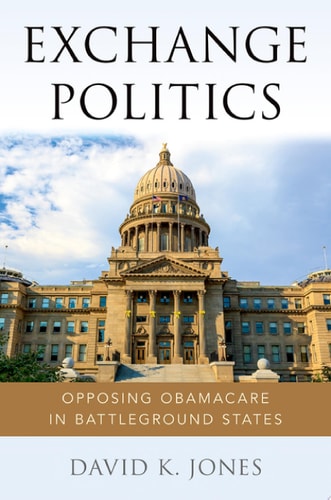
Exchange Politics: Opposing Obamacare in Battleground States
0
0
As an Amazon Associate and affiliate partner, Menrva Books earns from qualifying purchases. Learn more
Author Description
The Affordable Care Act (ACA) contained a threat that any state refusing to set up a health insurance exchange would lose control to the federal government. Republicans had supported the concept before it became part of Obamacare, and so virtually every state was expected to cooperate and implement this core part of the law through which millions would receive financial assistance to buy health insurance. However, 34 states refused to participate, using their flexibility as an opportunity to try to bring down the entire law. This is a stunning miscalculation by the Obama administration. This book tells the story of what happened in the final two states to choose state control (Idaho and New Mexico) and the two that came the closest but did not (Michigan and Mississippi). Contrary to how it is typically described in the media, the most intense split was not between Republicans and Democrats, but within the Republican Party. Governors were the most important people in the fight over exchanges, but did not always get their way. The Tea Party was amazingly successful at defeating the most powerful interest groups. State-level and national conservative think tanks were important allies to the Tea Party. The relative power of these groups was shaped by differences in institutional design and procedures, such as whether a state has term limits and the length of legislative sessions. Opposition was more easily overcome in states whose conditions facilitated the development of legislative "pockets of expertise." This is a dramatic example of opponents using federalism to block national reform and serves as a warning of the challenge of inducing state cooperation in other policy domains such as the environment and education.
Menrva's Summary
THE THESIS
This book investigates why a majority of U.S. states refused to implement health insurance exchanges under the Affordable Care Act, despite initial expectations of cooperation. David K. Jones, a professor of health law, policy, and management, utilizes a comparative case study approach to analyze the political dynamics within state legislatures. He argues that the resistance was driven primarily by internal Republican Party conflicts rather than simple partisan divides, and that institutional factors like term limits significantly influenced the success of opposition movements.
THE SCOPE MAP
What You Will Find
- Comparative analysis of policy implementation in Idaho, New Mexico, Michigan, and Mississippi
- Examination of the influence of the Tea Party and conservative think tanks on state-level policy
- Analysis of how institutional design, such as legislative session length and term limits, affects policy outcomes
Scope Limits
- The study does not provide a comprehensive national survey of all 50 states
- The text does not focus on the legal challenges brought before the Supreme Court regarding the ACA
THE AUTHORITY PERSPECTIVE
Experts in political science and public health policy recognize this work as a detailed examination of the intersection between federalism and partisan polarization. Readers frequently note the academic density of the prose and the author's rigorous application of institutional theory to health policy outcomes.
Page Count:
221
Publication Date:
2017-01-01
Publisher:
Oxford University Press
ISBN-10:
0190677260
ISBN-13:
9780190677268
Local government
Medical policy
Federalism
Political History
American Government
Public Policy
Health Care