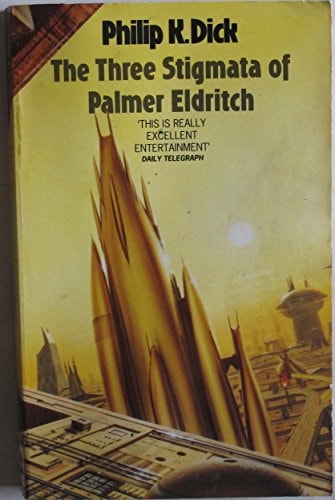
The Three Stigmata of Palmer Eldritch
0
0
As an Amazon Associate and affiliate partner, Menrva Books earns from qualifying purchases. Learn more
Author Description
The Three Stigmata of Palmer Eldritch is a 1965 science fiction novel by Philip K. Dick. It was nominated for the Nebula Award for Best Novel in 1965.[1] The novel takes place in 2016. Under United Nations authority, humankind has colonized every habitable planet and moon in the Solar System. Like many of Dick's novels, it utilizes an array of science fiction concepts, features several layers of reality and unreality and philosophical ideas. It is one of Dick's first works to explore religious themes.
Menrva's Summary
THE PULSE
When the enigmatic industrialist Palmer Eldritch returns from the Proxima system with a mysterious substance, the fragile boundary between reality and hallucination begins to collapse for the desperate colonists of the Solar System. Barney Mayerson, a precognitive draft dodger, finds himself caught in a corporate and existential power struggle as Eldritch’s drug, Chew-Z, threatens to replace the established, state-sanctioned reality of Can-D. The narrative utilizes a shifting, multi-perspective framework to track the erosion of the characters' sanity as they navigate a world where physical presence and subjective experience are no longer reliable. Opposed by the pervasive influence of Eldritch and the crushing weight of a colonized solar system, the protagonists must determine if their perceptions are genuine or merely manufactured by a malevolent force.
INSIDE THE PAGES
- Exploration of subjective reality versus objective truth
- Use of hallucinogenic substances as a narrative device
- Integration of religious and theological symbolism
- Depiction of a corporate-controlled, colonized solar system
- Nonlinear progression of psychological states
- Focus on the ethics of precognition and draft evasion
- Examination of the loss of individual identity
- Satirical commentary on consumerism and escapism
THE COLLECTIVE ECHO
This novel is widely regarded as a seminal work in the exploration of ontological instability within science fiction. Critics frequently highlight the text's ability to mirror the author's own preoccupations with the nature of existence and the potential for technological manipulation of the human mind. Readers often note the disorienting, claustrophobic atmosphere that defines the experience of the characters as they lose their grip on what is real. The work remains a cornerstone of the author's bibliography, frequently cited for its early and complex integration of religious themes into a futuristic setting. Its influence persists in discussions regarding the intersection of consciousness and artificial environments.
Page Count:
208
Publication Date:
1965-01-01
Publisher:
VOYAGER
ISBN-10:
0006482740
ISBN-13:
9780006482741
Dystopian
Science Fiction
Contemporary
Literature & Fiction
Psychological
Philosophical
Science Fiction