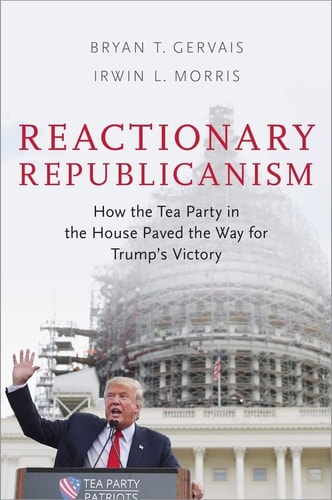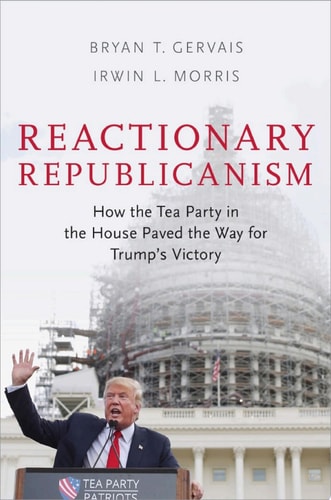
Reactionary Republicanism: How the Tea Party in the House Paved the Way for Trump's Victory
0
0
As an Amazon Associate and affiliate partner, Menrva Books earns from qualifying purchases. Learn more
Author Description
The shocking election of President Trump spawned myriad analyses and post-mortems, but they consistently underestimate the crucial role of the Tea Party on the GOP and Republican House members specifically. In Reactionary Republicanism, Bryan T. Gervais and Irwin L. Morris develop the most sophisticated analysis to date for gauging the Tea Party's impact upon the U.S. House of Representatives. They employ multiple types of data to illustrate the multi-dimensional impact of the Tea Party movement on members of Congress. Contrary to conventional wisdom, they find that Republicans associated with the Tea Party movement were neither a small minority of the Republican conference nor intransigent backbenchers. Most importantly, the invigoration of racial hostility and social conservatism among Tea Party supporters fostered the growth of reactionary Republicanism. Tea Party legislators, in turn, endeavored to aggravate these feelings of resentment via digital home styles that incorporated uncivil and aversion-inducing rhetoric. Trump fed off of this during his run, and his symbiotic relationship with Tea Party regulars has guided-and seems destined to-the trajectory of his administration.
Menrva's Summary
THE THESIS
How did the Tea Party movement within the U.S. House of Representatives fundamentally alter the Republican Party and facilitate the political rise of Donald Trump? Authors Bryan T. Gervais and Irwin L. Morris, both scholars of American politics, utilize a rigorous analytical framework to examine the legislative behavior and rhetoric of Republican House members. They argue that the Tea Party was not a fringe element but a significant force that leveraged racial hostility and social conservatism to reshape the GOP. By analyzing congressional voting patterns and digital communication strategies, the authors demonstrate how this shift created the necessary conditions for the populist surge that defined the 2016 election.
THE SCOPE MAP
What You Will Find
- Quantitative analysis of U.S. House voting records and legislative behavior.
- Examination of digital home styles and the use of uncivil rhetoric by legislators.
- Longitudinal study of the Tea Party's influence on Republican conference dynamics.
- Assessment of the symbiotic relationship between populist rhetoric and electoral success.
Scope Limits
- The study focuses primarily on the U.S. House of Representatives rather than the Senate or state-level legislatures.
- The analysis centers on the period leading up to and including the 2016 presidential election cycle.
THE AUTHORITY PERSPECTIVE
Political scientists and observers of American government frequently cite this work for its empirical rigor and its departure from conventional narratives regarding the Tea Party's influence. The text is noted for its academic density and its systematic approach to measuring the impact of rhetoric on legislative outcomes.
Page Count:
328
Publication Date:
2018-01-01
Publisher:
Oxford University Press
ISBN-10:
019087077X
ISBN-13:
9780190870775
History
American Politics
Conservatism
Conservatism & Liberalism
Government