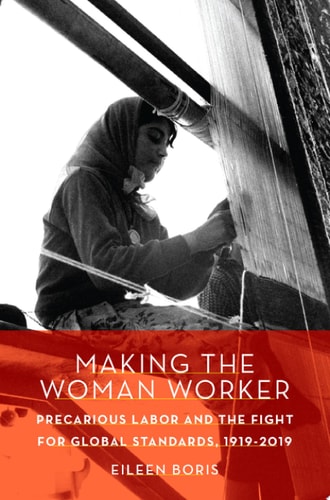
Making the Woman Worker: Precarious Labor and the Fight for Global Standards, 1919-2019
0
0
As an Amazon Associate and affiliate partner, Menrva Books earns from qualifying purchases. Learn more
Author Description
Founded in 1919 along with the League of Nations, the International Labour Organization (ILO) establishes labor standards and produces knowledge about the world of work, serving as a forum for nations, unions, and employer associations. Before WWII, it focused on enhancing conditions for male industrial workers in Western, often imperial, economies, while restricting the circumstances of women's labors. Over time, the ILO embraced non-discrimination and equal treatment. It now promotes fair globalization, standardized employment and decent work for women in the developing world. In Making the Woman Worker, Eileen Boris illuminates the ILO's transformation in the context of the long fight for social justice.Boris analyzes three ways in which the ILO has classified the division of labor: between women and men from 1919 to 1958; between women in the global south and the west from 1955 to 1996; and between the earning and care needs of all workers from 1990s to today. Before 1945, the ILO focused on distinguishing feminized labor from male workers, whom the organization prioritized. But when the world needed more women workers, the ILO (a UN agency after WWII) highlighted the global differences in women's work, began to combat sexism in the workplace, and declared care work essential to women's labor participation. Today, the ILO enters its second century with a mission to protect the interests of all workers in the face of increasingly globalized supply chains, the digitization of homework, and cross-border labor trafficking.As Boris shows, the ILO's treatment of women is a window into the modern history of labor. The historic relegation of feminized labor to the part-time, short-term, and low-waged prefigures the future organization of work. The labor force is increasingly self-employed and working as long as possible--a steep price for flexibility--with minimal governmental oversight. How we treat workers in the next century will inevitably build upon evolving ideas
Menrva's Summary
THE THESIS
How has the International Labour Organization (ILO) evolved in its classification and protection of women workers from its inception in 1919 to the present day? Eileen Boris, a historian specializing in labor and gender, utilizes archival records and institutional history to examine the shifting policies of the ILO. She argues that the organization's treatment of women serves as a critical lens for understanding the broader history of global labor, tracing the transition from exclusionary practices to contemporary efforts to address precarious employment and care work.
THE SCOPE MAP
What You Will Find
- Analysis of the ILO's shifting classification of labor divisions across three distinct historical periods.
- Examination of the transition from prioritizing male industrial workers to addressing global gender discrimination.
- Discussion of modern labor challenges including supply chain globalization, digital homework, and labor trafficking.
Scope Limits
- The text focuses primarily on the institutional history of the ILO rather than a comprehensive survey of all global labor unions.
- It does not provide a prescriptive policy manual for current labor organizers but rather a historical analysis of institutional frameworks.
THE AUTHORITY PERSPECTIVE
Scholars and labor historians recognize this work as a significant contribution to the study of international institutional policy and gendered labor dynamics. Readers frequently note the academic density of the prose and the depth of the historical research provided by the author.
Page Count:
352
Publication Date:
2019-01-01
Publisher:
Oxford University Press
ISBN-10:
0190874643
ISBN-13:
9780190874643
History
Economics
Sociology
International relations
Womens Studies
Modern History
Labor Studies
Women
Community Tags
Similar Books