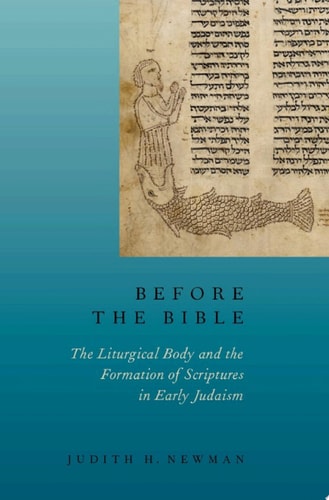
Before the Bible: The Liturgical Body and the Formation of Scriptures in Early Judaism
0
0
As an Amazon Associate and affiliate partner, Menrva Books earns from qualifying purchases. Learn more
Author Description
Before the Bible reveals the landscape of scripture in an era prior to the crystallization of the rabbinic Bible and the canonization of the Christian Bible. Most accounts of the formation of the Hebrew Bible trace the origins of scripture through source critical excavation of the archaeological "tel" of the Bible or the analysis of the scribal hand on manuscripts in text-critical work, but the discoveries in the Dead Sea Scrolls have transformed our understanding of scripture formation. Judith Newman focuses not on the putative origins and closure of the Bible, but on the reasons why scriptures remained open, with pluriform growth in the Hellenistic-Roman period.Drawing on new methods from cognitive neuroscience and the social sciences as well as traditional philological and literary analysis, Before the Bible argues that the key to understanding the formation of scripture is the widespread practice of individual and communal prayer in early Judaism. The figure of the teacher as a learned and pious sage capable of interpreting and embodying the tradition is central to understanding this revelatory phenomenon. The book considers the entwinement of prayer and scriptural formation in five books reflecting the diversity of early Judaism: Ben Sira, Daniel, Jeremiah/Baruch, Second Corinthians, and the Qumran Hodayot (Thanksgiving Hymns). While not a complete taxonomy of scripture formation, the book illuminates performative dynamics that have been largely ignored as well as the generative role of interpretive tradition in accounts of how the Bible came to be.
Menrva's Summary
THE THESIS
This book investigates how the practice of communal and individual prayer served as a primary mechanism for the formation and growth of scripture in early Judaism prior to the establishment of a closed canon. Judith H. Newman, a scholar of early Jewish and Christian literature, challenges traditional text-critical approaches by shifting the focus from scribal excavation to the performative and social context of the Hellenistic-Roman period. By integrating cognitive neuroscience and social science methodologies with philological analysis, she argues that the figure of the sage and the act of prayer were central to the development of pluriform scriptural traditions.
THE SCOPE MAP
What You Will Find
- Analysis of the relationship between liturgical practice and the growth of sacred texts.
- Examination of five specific texts: Ben Sira, Daniel, Jeremiah/Baruch, Second Corinthians, and the Qumran Hodayot.
- Application of cognitive neuroscience and social science frameworks to historical religious development.
Scope Limits
- The book does not provide a comprehensive taxonomy of all scripture formation processes in antiquity.
- It does not focus on traditional archaeological or source-critical excavation of the Hebrew Bible.
THE AUTHORITY PERSPECTIVE
Scholars recognize this work as a significant shift in the study of canonization, moving away from static text-critical models toward a more dynamic, performative understanding of religious tradition. Readers frequently note the academic density of the prose and the interdisciplinary approach, which requires a foundational knowledge of early Jewish history and biblical studies.
Page Count:
192
Publication Date:
2018-01-01
Publisher:
Oxford University Press
ISBN-10:
0190873507
ISBN-13:
9780190873509
History
Religion
Ancient History
Prayer_judaism
Theology
Judaism
Bible
Bibles
Community Tags
Similar Books