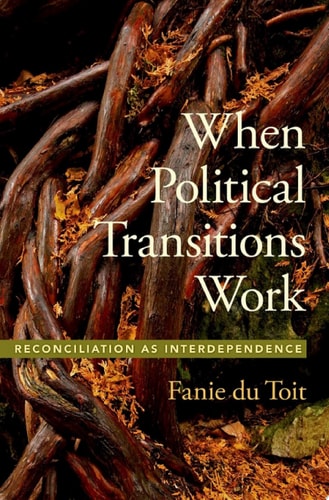
When Political Transitions Work: Reconciliation as Interdependence
0
0
As an Amazon Associate and affiliate partner, Menrva Books earns from qualifying purchases. Learn more
Author Description
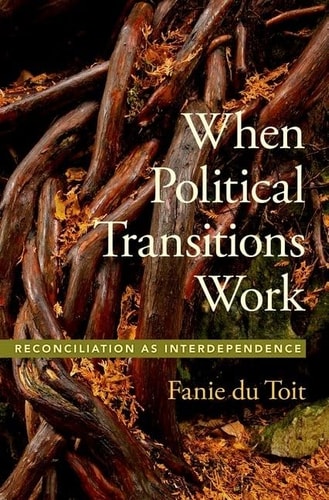
The peaceful end of apartheid in South Africa was a monumental event in late twentieth century history. A racist regime built upon a foundation of colonialist exploitation, South Africa had become by that point a tinderbox: suffused with day-to-day violence and political extremism on all sides. Yet two decades later it was a stable democracy with a growing economy. How did such a deeply divided, conflicted society manage this remarkable transition?In When Political Transitions Work, Fanie du Toit, who has been a participant and close observer in post-conflict developments throughout Africa for decades, offers a new theory for why South Africa's reconciliation worked and why its lessons remain relevant for other nations emerging from civil conflicts. He uses reconciliation as a framework for political transition and seeks to answer three key questions: how do the reconciliation processes begin; how can political transitions result in inclusive and fair institutional change; and to what extent does reconciliation change the way a society functions? Looking at South Africa, one of reconciliation's most celebrated cases, du Toit shows that the key ingredient to successful reconciliations is acknowledging the centrality of relationships. He further develops his own theoretical approach to reconciliation-as-interdependence-the idea that reconciliation is the result of an integrated process of courageous leadership, fair and inclusive institutions, and social change built toward a mutual goal of prosperity.As du Toit conveys, the motivation for reconciliation is the long-term well-being of one's own community, as well as that of enemy groups. Without ensuring the conditions in which one's enemy can flourish, one's own community is unlikely to prosper sustainably.
Menrva's Summary
THE THESIS
This book investigates the mechanisms behind successful political transitions by analyzing the role of reconciliation as a driver for sustainable institutional change. Fanie du Toit, a veteran observer of post-conflict developments in Africa, utilizes the South African transition from apartheid to democracy as a primary case study. He argues that reconciliation is not merely a moral endeavor but a strategic necessity rooted in interdependence, where the prosperity of one group is inextricably linked to the flourishing of its former adversaries.
THE SCOPE MAP
What You Will Find
- A theoretical framework defining reconciliation-as-interdependence
- Analysis of the transition from apartheid to a stable democracy in South Africa
- Examination of the intersection between leadership, institutional reform, and social change
Scope Limits
- The text focuses primarily on the South African model and may not account for all variables in non-African geopolitical contexts
- It does not provide a comprehensive history of the entire apartheid era, focusing instead on the transition period
THE AUTHORITY PERSPECTIVE
Scholars and practitioners in the field of peacebuilding identify this work as a significant contribution to understanding the practical application of reconciliation in post-conflict societies. Readers frequently note that the author's dual role as a participant and academic provides a unique, grounded perspective on the complexities of political reform.
Page Count:
312
Publication Date:
2018-08-24
Publisher:
Oxford University Press
ISBN-10:
0190881852
ISBN-13:
9780190881856
South Africa
African history
Africa - History
Reconciliation
International relations
Peace studies
Conflict Resolution