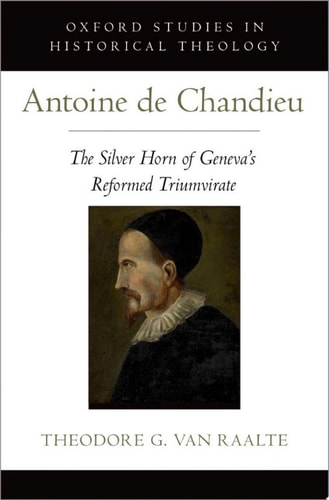
Antoine de Chandieu: The Silver Horn of Geneva's Reformed Triumvirate
0
0
As an Amazon Associate and affiliate partner, Menrva Books earns from qualifying purchases. Learn more
Author Description
Offering the first study in any language dedicated to the influential publications of the French Reformed theologian Antoine de Chandieu (1534-1591), Theodore Van Raalte begins by recalling Chandieu's reputation as it stood at the death of Theodore Beza in 1605. Poets in Geneva mourned the end of an era of star theologians, reminiscing about Geneva's Reformed triumvirate of gold, silver, and bronze: gold represented Calvin; silver Chandieu; and bronze Beza. Van Raalte's work sets Chandieu within the context of Reformed theology in Geneva, the wider history of scholastic method in the Swiss cantons, and the gripping social and political milieux of this tumultuous time. Chandieu was far from a mere ivory tower theologian: as a member of French nobility in possession of many estates and castles in France, he and his family acutely experienced the misery and triumph of the French Huguenots during the Wars of Religion. Connected to royalty from the beginning of his career, Chandieu later served the future Henry IV as personal military chaplain and cryptographer. His writings run the gamut from religious poetry (put to music by others in his lifetime) to carefully-crafted disputations which saw publication in his posthumous Opera Theologica in five editions between 1592 and 1620. Chandieu had developed a very elaborate form of the medieval quaestio disputata and made liberal use of hypothetical syllogisms. Van Raalte argues that Chandieu utilized scholastic method in theology for the sake of clarity of argument, rootedness in Scripture, and certainty of faith.
Menrva's Summary
THE THESIS
This work investigates the theological contributions and historical significance of Antoine de Chandieu, a central yet understudied figure in the Genevan Reformed tradition. Theodore G. Van Raalte, a scholar of historical theology, utilizes primary source analysis of Chandieu's posthumous Opera Theologica and historical records of the French Wars of Religion to reconstruct the theologian's intellectual framework. The book argues that Chandieu’s application of scholastic methodology was not a departure from piety, but a deliberate tool to enhance scriptural clarity and theological certainty during a period of intense religious and political upheaval.
THE SCOPE MAP
What You Will Find
- An analysis of the scholastic quaestio disputata method as applied by Chandieu.
- Historical context regarding the French Huguenot experience during the Wars of Religion.
- Examination of Chandieu’s dual role as a nobleman, military chaplain, and cryptographer for Henry IV.
- A survey of Chandieu’s literary output, ranging from religious poetry to formal theological disputations.
Scope Limits
- The study focuses primarily on the theological and intellectual output of Chandieu rather than a comprehensive biography of his entire family lineage.
- The text assumes a baseline familiarity with 16th-century Reformed theology and the political landscape of the Swiss cantons.
THE AUTHORITY PERSPECTIVE
Scholars in the field of Reformation studies identify this work as a significant contribution to the understanding of post-Calvinist scholasticism. Readers frequently note the academic density of the prose, which provides a rigorous examination of primary source material for specialists in historical theology.
Page Count:
376
Publication Date:
2018-01-01
Publisher:
Oxford University Press
ISBN-10:
0190882204
ISBN-13:
9780190882204
History
Biography
Religion
Theology
Reformation
Theologians
European History
Community Tags
Similar Books