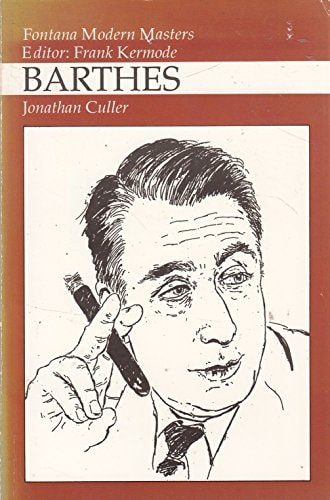
Barthes
0
0
As an Amazon Associate and affiliate partner, Menrva Books earns from qualifying purchases. Learn more
Author Description
Roland Barthes was the leading figure of French Structuralism, the theoretical movement of the 1960s which revolutionized the study of literature and culture, as well as history and psychoanalysis. But Barthes was a man who disliked orthodoxies. His shifting positions and theoretical interests make him hard to grasp and assess. This book surveys Barthes' work in clear, accessible prose, highlighting what is most interesting and important in his work today. In particular, the book describes the many projects, which Barthes explored and which helped to change the way we think about a range of cultural phenomena--from literature, fashion, wrestling, and advertising to notions of the self, of history, and of nature.
Menrva's Summary
THE THESIS
This book investigates the intellectual trajectory of Roland Barthes, seeking to clarify his role as a central figure in French Structuralism while accounting for his persistent rejection of rigid theoretical orthodoxies. Jonathan Culler, a distinguished scholar of literary theory, utilizes a thematic approach to synthesize Barthes' diverse body of work. By examining the evolution of Barthes' thought, Culler provides a framework for understanding how his shifting interests fundamentally altered the academic approach to cultural phenomena and semiotics.
THE SCOPE MAP
What You Will Find
- An overview of French Structuralism and its impact on 20th-century intellectual history.
- Analysis of Barthes' diverse subjects including fashion, wrestling, advertising, and literature.
- Examination of Barthes' evolving perspectives on the self, history, and nature.
- A synthesis of Barthes' methodology for decoding cultural signs and social myths.
THE AUTHORITY PERSPECTIVE
This work is regarded as a foundational, accessible introduction to Barthes' complex intellectual output, favored for its clarity in navigating dense theoretical terrain. The text serves as a reliable entry point for students and scholars seeking to understand the mechanics of Barthes' critical influence on modern cultural studies.
Page Count:
128
Publication Date:
1990-01-01
Publisher:
HarperCollins Publishers Canada, Limited
ISBN-10:
0006862071
ISBN-13:
9780006862079
Philosophy
Biography
Structuralism
Literary Criticism
Philologists
Barthes Roland
Community Tags
Similar Books