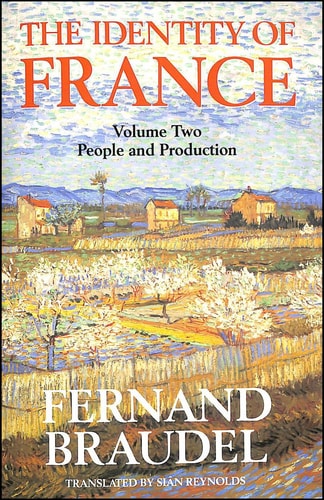
The Identity of France: People and Production
0
0
As an Amazon Associate and affiliate partner, Menrva Books earns from qualifying purchases. Learn more
Author Description
In this personal approach to the history of France the author shows himself a part of all that he has met. He describes the geographical circumstances of the country, her fertility, her internal and external communications and the villages, towns and cities in which her people gathered. As he describes the situation he questions - why did Paris become the capital of France rather than Toulouse? What is a frontier? What did it mean in the 15th century? How did France become unified in the way that she did? Thus he shows how all this, which lies behind the outline, determined the shape of France. The author also wrote " The Mediterranean" and "Civilization and Capitalism".
Menrva's Summary
THE THESIS
Fernand Braudel investigates how the interplay between geographical constraints, economic production, and social structures forged the unique national identity of France. As a preeminent historian of the Annales school, Braudel utilizes his signature long-term perspective to examine the material conditions that dictated the development of French society. He argues that the nation's character is not merely a product of political events, but the result of deep-seated environmental and economic realities that evolved over centuries.
THE SCOPE MAP
What You Will Find
- Analysis of geographical factors including fertility, climate, and terrain.
- Examination of internal and external communication networks and trade routes.
- Historical study of urban development, from rural villages to the rise of Paris.
- Exploration of the concept of frontiers and the process of national unification.
THE AUTHORITY PERSPECTIVE
This work is widely regarded as a monumental contribution to historiography, reflecting Braudel's mastery of the 'longue durée' approach to historical analysis. The text provides a dense, scholarly examination of France that remains a foundational reference for historians interested in the intersection of geography and human activity.
Page Count:
784
Publication Date:
1991-09-26
Publisher:
Fontana Collins
ISBN-10:
0006862314
ISBN-13:
9780006862314
Economics
History
French History
European History
France
Social History
Geography
Community Tags
Similar Books