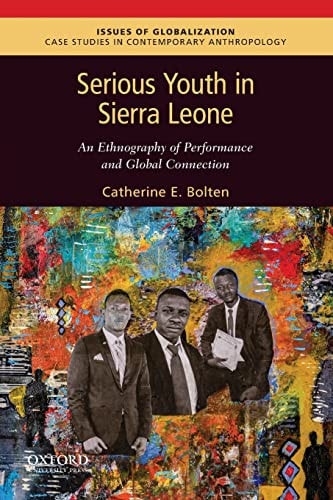
Serious Youth in Sierra Leone: An Ethnography of Performance and Global Connection
0
0
As an Amazon Associate and affiliate partner, Menrva Books earns from qualifying purchases. Learn more
Author Description
Generational anxieties over what will happen to the young are unfolding starkly in Sierra Leone, where the civil war that raged between 1991 and 2002--characterized by the extreme youthfulness of the rebel movement--triggered mass fear of that generation being "lost." Even now, fifteen years later, "children of the war" are regarded with suspicion. These fears stem largely from young people's easy embrace of globalization, enabled by the flood of international humanitarian aid following the war. Sierra Leone's increasingly global connectivity has triggered a cultural arms race between adults and their children, with adults often controlling, manipulating, and quashing the ambitions of the young.Through an investigation of the lives and struggles of Sierra Leonean youth in the northern capital town of Makeni, Serious Youth in Sierra Leone: An Ethnography of Performance and Global Connection turns these fears on their head. Author Catherine Bolten argues that urban youth in Makeni are largely a conservative social force, rather than rebellious or revolutionary--the young want to have steady incomes, start families, and be respected. Adults misrecognize their children's conservative values and desires as radical because they interpret global engagement as a desire for social upheaval, rather than as a way to be noticed and taken seriously. Bolten articulates the social processes that lead to children--the future of a society--becoming a representation of a society's deepest anxieties about the destruction of its values and ideologies, and why those might be falsely construed.Serious Youth in Sierra Leone is a volume in the series ISSUES OF GLOBALIZATION: CASESTUDIES IN CONTEMPORARY ANTHROPOLOGY, which examines the experiences of individual communities in our contemporary world. Each volume offers a brief and engaging exploration of a particular issue arising from globalization and its cultural, political, and economic effects on certain peoples or groups.
Menrva's Summary
THE THESIS
This ethnography investigates the disconnect between adult perceptions of youth radicalism and the actual conservative social aspirations of young people in post-war Sierra Leone. Catherine Bolten, an anthropologist, utilizes extensive fieldwork conducted in the northern town of Makeni to analyze how the legacy of civil war and the influx of global humanitarian aid have shaped intergenerational tensions. She argues that while adults view youth engagement with global culture as a threat to traditional values, the youth are primarily seeking stability, employment, and social recognition within existing structures.
THE SCOPE MAP
What You Will Find
- Analysis of the cultural arms race between generations in post-conflict Sierra Leone.
- Examination of how global connectivity and humanitarian aid influence local social hierarchies.
- Ethnographic data focused on the town of Makeni and the lives of its young residents.
Scope Limits
- The study is geographically concentrated in Makeni and may not represent the entirety of Sierra Leonean youth experiences.
- The research focuses on the specific period following the 1991-2002 civil war and does not cover subsequent political developments.
THE AUTHORITY PERSPECTIVE
Scholars in the field of anthropology recognize this work as a significant contribution to the study of post-conflict societies and the impact of globalization on local youth identities. Readers frequently note the academic rigor of the ethnographic approach and the clarity with which Bolten challenges prevailing stereotypes about the so-called lost generation.
Page Count:
224
Publication Date:
2019-10-01
Publisher:
Oxford University Press
ISBN-10:
0190886684
ISBN-13:
9780190886684
Anthropology
West Africa
Globalization
Conflict Studies
Youth africa
Sociology
Sierra Leone
Youth Studies
Community Tags
Similar Books