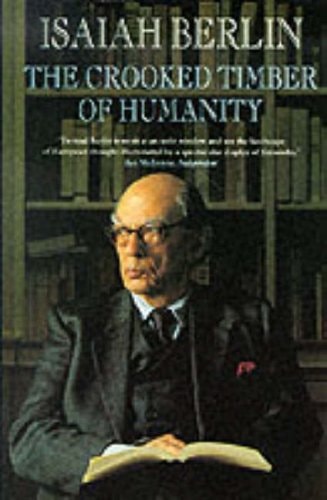
The Crooked Timber of Humanity
0
0
As an Amazon Associate and affiliate partner, Menrva Books earns from qualifying purchases. Learn more
Author Description
The Crooked Timber of Humanity contains eight of Isaiah Berlin's deservedly influential essays in the history of ideas, all dealing with political thought in the 18th and 19th centuries. One of the essays, "Joseph de Maistre and the Origins of Fascism," is published here for the first time; this reevaluation of the Savoyard counterrevolutionary occupies almost a quarter of the book, and not a word is wasted. Although written separately, these essays exhibit a common concern with what Berlin calls pluralism, the idea that there can be different, equally valid but mutually incompatible, conceptions of how to live. Whatever their disagreements, traditional writers on politics have implicitly assumed that there is one best way to live, whether it was in the static utopias of More and Harrington or in the dynamic dramas of Hegel and Marx. But in the 18th century, Vico and Herder embraced pluralism, thus inaugurating the historicist turn in political thought. Berlin adeptly pursues pluralism and its repercussions through history, connecting it to the decline of utopian ideas, the origins of fascism and nationalism, the rise of the discipline of cultural history, and much else. As always, Berlin's prose is graceful and powerful, but what truly makes The Crooked Timber of Humanity exhilarating to read is the depth and power of his intellect. Berlin credits Vico with realizing that "to exercise their proper function, historians require the capacity for imaginative insight, without which the bones of the past remain dry and lifeless." It is a capacity that Berlin himself amply displays here. --Glenn Branch
Menrva's Summary
THE THESIS
This collection investigates the tension between the pursuit of universal political truths and the reality of value pluralism, challenging the assumption that there is a single best way for human societies to exist. Isaiah Berlin, a preeminent historian of ideas, utilizes these eight essays to examine how thinkers from the 18th and 19th centuries grappled with the incompatibility of human ideals. By tracing the development of historicism through figures like Vico and Herder, Berlin argues that the rejection of utopian monism is essential for understanding the complexities of modern political movements, including the emergence of fascism and nationalism.
THE SCOPE MAP
What You Will Find
- Analysis of political thought in the 18th and 19th centuries
- Examination of the origins of fascism through the work of Joseph de Maistre
- Exploration of value pluralism as a counter-narrative to utopian political systems
- Discussion on the rise of cultural history and the historicist turn
THE AUTHORITY PERSPECTIVE
The text is widely regarded as a significant contribution to political philosophy, noted for its intellectual rigor and the clarity of Berlin's prose. It serves as a dense, scholarly resource for readers interested in the evolution of modern political thought and the critique of utopianism.
Page Count:
288
Publication Date:
1991-01-01
Publisher:
Alfred A Knopf
ISBN-10:
0006862217
ISBN-13:
9780006862215
History
Politics
Philosophy
History & Surveys
Modern
Political Theory
Educational Resources
History of Ideas
Intellectual History
Essays
Literature & Fiction