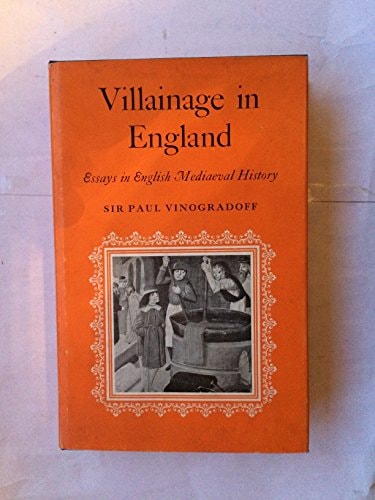
Villainage in England: Essays in English Mediaeval History
0
0
As an Amazon Associate and affiliate partner, Menrva Books earns from qualifying purchases. Learn more
Author Description
Vinogradoff argues that the Norman-era villain was the direct descendent of the Anglo-Saxon freeman, so the typical Anglo-Saxon settlement was a free community rather than a manor. An impressive work of original scholarship and synthesis, it "shed a wholly new light on the social and legal aspects of the institution of villainage" (William Holdsworth, The Historians of English Law 86). xii, 464 pp.
Menrva's Summary
THE THESIS
This work investigates the legal and social origins of the medieval English villain to determine whether the status was a product of Norman imposition or a continuation of Anglo-Saxon social structures. Paul Vinogradoff, a distinguished legal historian, utilizes extensive primary source analysis of manorial records and legal documents to challenge the prevailing view that the Norman Conquest fundamentally transformed the status of the peasantry. He argues that the typical Anglo-Saxon settlement functioned as a free community, suggesting that the institution of villainage evolved from earlier social conditions rather than being an abrupt creation of the post-Conquest era.
THE SCOPE MAP
What You Will Find
- Analysis of manorial records and legal statutes from the Norman and Anglo-Saxon periods.
- Examination of the social status of the peasantry and the transition from freeman to villain.
- Comparative study of land tenure systems and community organization in medieval England.
- Evaluation of the influence of Norman administrative structures on existing local customs.
THE AUTHORITY PERSPECTIVE
Historians and legal scholars recognize this text as a foundational study that shifted the academic understanding of medieval social hierarchies. Readers frequently note the dense, scholarly nature of the prose, which remains a standard reference for those studying the evolution of English land law.
Page Count:
478
Publication Date:
1968-01-01
Publisher:
Clarendon Press
ISBN-10:
0198213816
ISBN-13:
9780198213819
History
Educational Resources
Legal History
Europe
England
Social History
Essays
Community Tags
Similar Books