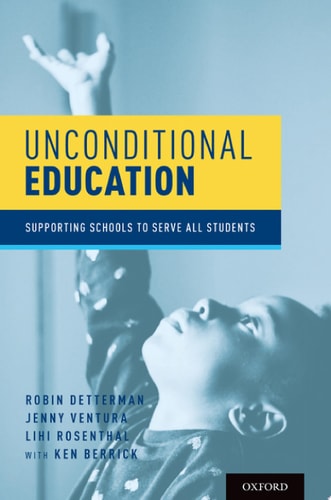
Unconditional Education
0
0
As an Amazon Associate and affiliate partner, Menrva Books earns from qualifying purchases. Learn more
Author Description
After decades of reform, America's public schools continue to fail particular groups of students; the greatest opportunity gaps are faced by those whose achievement is hindered by complex stressors, including disability, trauma, poverty, and institutionalized racism. When students' needs overwhelm the neighborhood schools assigned to serve them, they are relegated to increasingly isolated educational environments. Unconditional Education (UE) offers an alternate approach that transforms schools into communities where all students can thrive. It reduces the need for more intensive and costly future remediation by pairing a holistic, multi-tiered system of supports with an intentional focus on overall culture and climate, and promotes systematic coordination and integration of funding and services by identifying gaps and eliminating redundancies to increase the efficient allocation of available resources. This book is an essential resource for mental health and educational stakeholders (i.e., school social workers, therapists, teachers, school administrators, and district-level leaders) who are interested in adopting an unconditional approach to supporting the students within their schools.
Menrva's Summary
THE THESIS
This book investigates how public schools can overcome systemic failure by implementing the Unconditional Education (UE) framework to support students facing complex stressors. The authors, a team of educational and mental health professionals, argue that traditional reform efforts often ignore the intersection of trauma, poverty, and disability. They present a holistic, multi-tiered system of supports designed to integrate school culture, funding, and clinical services to ensure that no student is relegated to isolated environments.
THE SCOPE MAP
What You Will Find
- A multi-tiered system of supports (MTSS) framework tailored for high-need populations
- Strategies for integrating mental health services within the school environment
- Methodologies for identifying funding gaps and eliminating service redundancies
- Approaches to improving school climate and culture for marginalized students
Scope Limits
- The text focuses primarily on the American public school system and may not apply to international educational models
- It does not provide specific curriculum design but focuses on systemic and administrative support structures
THE AUTHORITY PERSPECTIVE
Practitioners and administrators frequently cite this text as a practical manual for restructuring school-based support services. Experts highlight the book's utility in bridging the gap between clinical mental health interventions and daily classroom management.
Page Count:
224
Publication Date:
2019-01-01
Publisher:
Oxford University Press
ISBN-10:
0190886528
ISBN-13:
9780190886523
Special Education
Pedagogy
Educational Reform
Social Work
Education
School Administration
Community Tags
Similar Books