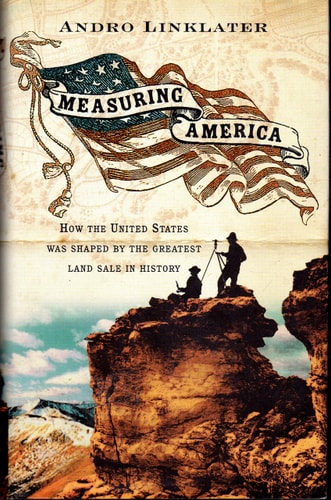
Measuring America: How the United States Was Shaped by the Greatest Land Sale in History
0
0
As an Amazon Associate and affiliate partner, Menrva Books earns from qualifying purchases. Learn more
Author Description
The epic story of how the gigantic land of America acquired its unique shape across 3000 miles of territory, and how the largest land survey in history paved the way both for a colossal sale of property and for the embedding of democracy and the spirit of independence in the psyche of Americans.The sheer scale of it makes the measuring of America extraordinary. Beginning in 1785, it became the largest land survey in history stretching from the Ohio river to the Pacific coast and from Lake Erie to the Mexican border. It prepared the ground for the sale of almost two billion acres, and shaped landscapes and cities across the US more drastically than any event since the last ice age.Before the survey could begin, there had to be agreement about what kind of measurement should be used. What made the 18th-century debate so critical was the revolution taking place in Western thought as objective, scientific reasoning challenged the traditional, subjective view of the world. A battle began between those (like the British) supporting a centuries-old organic form of measurement (ounces and pounds, yards and acres) and the modernizers, like Thomas Jefferson, who backed a system based on scientific observation.The effects of the measuring of America on the landscape and people (native and immigrant) were huge and long-lasting; the story itself an exotic blend of narrative history and popular science
Menrva's Summary
THE THESIS
This book investigates how the systematic surveying and measurement of the American landscape between 1785 and the mid-19th century fundamentally structured the nation's physical geography and democratic identity. Author Andro Linklater utilizes historical records, scientific debates of the 18th century, and land survey data to argue that the transition from subjective, traditional measurement to objective, scientific standards was a prerequisite for the largest land sale in history. By examining the tension between organic, colonial measurement systems and the rationalist approach championed by figures like Thomas Jefferson, the text illustrates how these technical decisions dictated the development of cities, property rights, and the American psyche.
THE SCOPE MAP
What You Will Find
- The historical progression of the Public Land Survey System starting in 1785.
- The intellectual conflict between traditional British measurement units and the emerging scientific decimal-based systems.
- Analysis of how the grid system influenced the physical layout of American landscapes and urban centers.
- The socio-political impact of land distribution on both immigrant settlers and indigenous populations.
THE AUTHORITY PERSPECTIVE
This work is regarded as a meticulous synthesis of technical history and narrative storytelling that clarifies the often-overlooked role of measurement in nation-building. The text provides a dense, scholarly examination of how abstract scientific principles were translated into the tangible, gridded reality of the American frontier.
Page Count:
336
Publication Date:
2002-01-01
Publisher:
Walker & Co.
ISBN-10:
0007108877
ISBN-13:
9780007108879
History
Non-Fiction
Surveyors
Public lands
United States
Ohio History
Geography
Land Use
Pioneer Life
Science History
National characteristics American
Ohio River Valley -- Geography
Surveying
Community Tags
Other Editions(3)
Similar Books