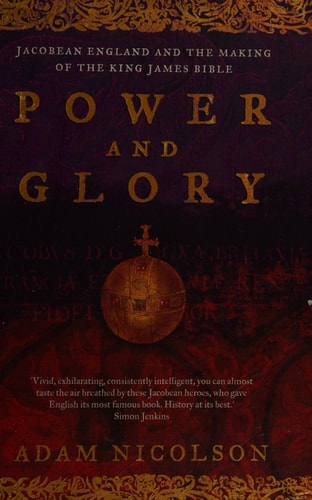
Power and Glory: Jacobean England and the Making of the King James Bible
0
0
As an Amazon Associate and affiliate partner, Menrva Books earns from qualifying purchases. Learn more
Author Description
James VI of Scotland - James I of England - came into his new kingdom in 1603. Trained almost from birth to manage rival political factions, he was determined not only to hold his throne, but to avoid the strife caused by religious groups that was bedevilling most European countries. He would hold his God-appointed position and unify his kingdom. Out of these circumstances, and involving the very people who were engaged in the bitterest controversies, a book of extraordinary grace and lasting literary appeal was created: the King James Bible.
Menrva's Summary
THE THESIS
This work investigates how the political instability and religious factionalism of early 17th-century England necessitated the creation of the King James Bible as a tool for national unification. Adam Nicolson, an acclaimed historian, utilizes primary source documents and historical analysis to reconstruct the volatile environment of the Jacobean court. He argues that the translation project was not merely a theological endeavor, but a calculated political maneuver by King James I to consolidate power and harmonize a fractured kingdom. By examining the lives and motivations of the translators, Nicolson reveals the complex interplay between statecraft and scripture during a pivotal era of English history.
THE SCOPE MAP
What You Will Find
- Detailed analysis of the Jacobean political landscape and the transition of power in 1603.
- Biographical profiles of the key scholars and theologians commissioned for the translation.
- Examination of the religious tensions between Puritans, Anglicans, and Catholics.
- Historical context regarding the evolution of the English language and literary standards of the period.
THE AUTHORITY PERSPECTIVE
The text provides a dense, scholarly examination of the intersection between monarchical authority and religious scholarship. It is regarded as a comprehensive account for readers interested in the socio-political origins of one of the most influential texts in the English language.
Page Count:
280
Publication Date:
2003-01-01
Publisher:
HarperCollins
ISBN-10:
0007108931
ISBN-13:
9780007108930
Biography
History
Religion
Great Britain
Royalty
Christianity
History & Culture
Biography Autobiography
British History
Europe
Community Tags
Similar Books