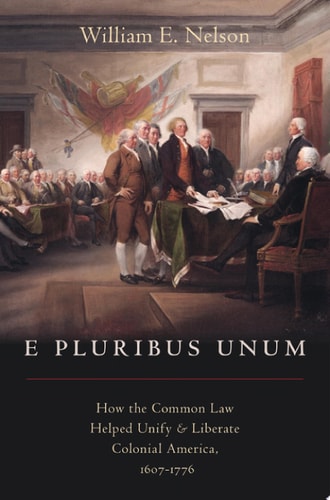
E Pluribus Unum: How the Common Law Helped Unify and Liberate Colonial America, 1607-1776
0
0
As an Amazon Associate and affiliate partner, Menrva Books earns from qualifying purchases. Learn more
Author Description
The colonies that comprised pre-revolutionary America had thirteen legal systems and governments. Given their diversity, how did they evolve into a single nation? In E Pluribus Unum, the eminent legal historian William E. Nelson explains how this diverse array of legal orders gradually converged over time, laying the groundwork for the founding of the United States. From their inception, the colonies exercised a range of approaches to the law. For instance, while New England based its legal system around the word of God, Maryland followed the common law tradition, and New York adhered to Dutch law. Over time, though, the British crown standardized legal procedure in an effort to more uniformly and efficiently exert control over the Empire. But, while the common law emerged as the dominant system across the colonies, its effects were far from what English rulers had envisioned.E Pluribus Unum highlights the political context in which the common law developed and how it influenced the United States Constitution. In practice, the triumph of the common law over competing approaches gave lawyers more authority than governing officials. By the end of the eighteenth century, many colonial legal professionals began to espouse constitutional ideology that would mature into the doctrine of judicial review. In turn, laypeople came to accept constitutional doctrine by the time of independence in 1776.Ultimately, Nelson shows that the colonies' gradual embrace of the common law was instrumental to the establishment of the United States. Not simply a masterful legal history of colonial America, Nelson's magnum opus fundamentally reshapes our understanding of the sources of both the American Revolution and the Founding.
Menrva's Summary
THE THESIS
This work investigates how the disparate legal systems of the thirteen American colonies converged into a unified common law tradition, ultimately facilitating the creation of the United States. William E. Nelson, a prominent legal historian, utilizes extensive archival research to trace the evolution of colonial jurisprudence from 1607 to 1776. He argues that while the British Crown intended to use the common law as a tool for imperial control, the system instead empowered colonial lawyers and fostered the constitutional ideologies that led to the American Revolution and the doctrine of judicial review.
THE SCOPE MAP
What You Will Find
- Analysis of the transition from diverse colonial legal frameworks, such as Dutch law and religious-based codes, to a unified common law.
- Examination of the political influence of colonial legal professionals and the rise of judicial authority.
- Historical context regarding the development of constitutional doctrine leading up to 1776.
Scope Limits
- The text focuses primarily on the legal and political evolution of the colonies rather than social or economic history.
- The analysis concludes at the onset of American independence and does not detail the post-revolutionary application of these legal principles.
THE AUTHORITY PERSPECTIVE
Legal scholars and historians recognize this work as a significant contribution to the understanding of the intellectual origins of the American Founding. Readers frequently note the academic density of the prose, which provides a rigorous examination of how legal procedure shaped early American political identity.
Page Count:
284
Publication Date:
2019-01-01
Publisher:
Oxford University Press
ISBN-10:
0190880821
ISBN-13:
9780190880828
History
Professional Career & Trade
Common Law
American History
Law history
Legal History
Law
Community Tags
Similar Books