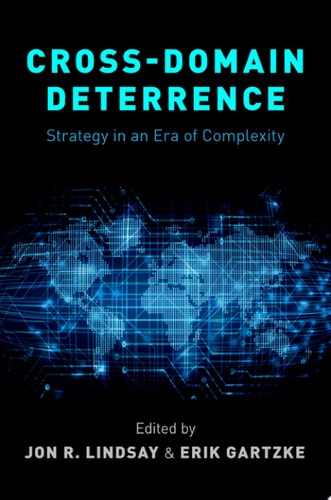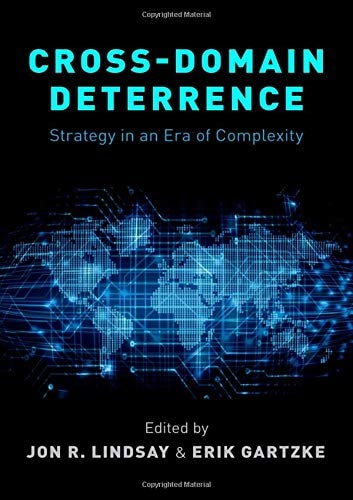
Cross-Domain Deterrence: Strategy in an Era of Complexity
0
0
As an Amazon Associate and affiliate partner, Menrva Books earns from qualifying purchases. Learn more
Author Description
The complexity of the twenty-first century threat landscape contrasts markedly with the bilateral nuclear bargaining context envisioned by classical deterrence theory. Nuclear and conventional arsenals continue to develop alongside anti-satellite programs, autonomous robotics or drones, cyber operations, biotechnology, and other innovations barely imagined in the early nuclear age. The concept of cross-domain deterrence (CDD) emerged near the end of the George W. Bush administration as policymakers and commanders confronted emerging threats to vital military systems in space and cyberspace. The Pentagon now recognizes five operational environments or so-called domains (land, sea, air, space, and cyberspace), and CDD poses serious problems in practice. In Cross-Domain Deterrence, Erik Gartzke and Jon R. Lindsay assess the theoretical relevance of CDD for the field of International Relations. As a general concept, CDD posits that how actors choose to deter affects the quality of the deterrence they achieve. Contributors to this volume include senior and junior scholars and national security practitioners. Their chapters probe the analytical utility of CDD by examining how differences across, and combinations of, different military and non-military instruments can affect choices and outcomes in coercive policy in historical and contemporary cases.
Menrva's Summary
THE THESIS
This volume investigates how the expansion of military capabilities across multiple operational domains—land, sea, air, space, and cyberspace—alters the traditional logic of deterrence. Authors Erik Gartzke and Jon R. Lindsay, both established scholars in international security, curate a collection of essays that evaluate whether classical deterrence theory remains applicable in an era of technological complexity. By synthesizing historical case studies and contemporary policy challenges, the contributors argue that the ability to leverage cross-domain threats fundamentally changes the calculus of coercive diplomacy.
THE SCOPE MAP
What You Will Find
- Theoretical framework for cross-domain deterrence (CDD) in modern international relations.
- Analysis of military and non-military instruments including cyber operations, anti-satellite programs, and autonomous systems.
- Comparative study of historical and contemporary coercive policy outcomes.
Scope Limits
- The text does not provide a prescriptive manual for tactical military operations.
- It does not offer a comprehensive technical guide to specific cyber or space-based weaponry.
THE AUTHORITY PERSPECTIVE
Experts identify this work as a significant contribution to the evolving field of security studies, noting its utility for both academic researchers and policy practitioners. Readers frequently highlight the analytical rigor of the chapters, which successfully bridge the gap between abstract strategic theory and practical application in the modern threat landscape.
Page Count:
408
Publication Date:
2019-03-01
Publisher:
Oxford University Press
ISBN-10:
0190908653
ISBN-13:
9780190908652
National security
Military Strategy
International relations
Cybersecurity
Geopolitics
Community Tags
Similar Books