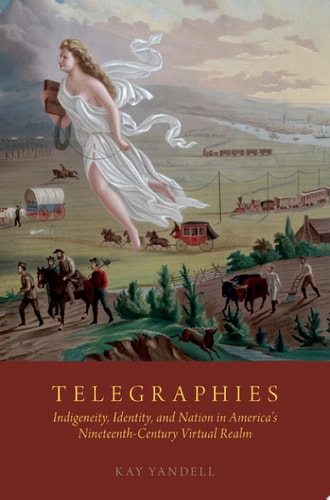
Telegraphies
0
0
As an Amazon Associate and affiliate partner, Menrva Books earns from qualifying purchases. Learn more
Author Description
Telegraphies explores literatures envisioning the literary, societal, even the perceived metaphysical effects of various cultures' telecommunications technologies, to argue that nineteenth-century Americans tested in the virtual realm new theories of self, place, nation, and God. The book opens by discussing such Native American telecommunications technologies as smoke signals and sign language chains, to challenge common notions that long-distance speech practices emerged only in conjunction with capitalist industrialization. Kay Yandell analyzes the cultural interactions and literary productions that arose as Native telegraphs worked with and against European American telecommunications systems across nineteenth-century America. Into this conversation Telegraphies integrates visions of Morse's electromagnetic telegraph, with its claim to speak new, coded words and to send bodiless, textless prose instantly across the miles. Such writers as Frederick Douglass, Walt Whitman, and Ella Cheever Thayer crafted memoirs, poetic odes, and novels that envision how the birth of instantaneous communication across a vast continent forever alters the way Americans speak, write, build community, and conceive of the divine. While some writers celebrated far-speaking technologies as conduits of a metaphysical Manifest Destiny to overspread America's primitive cultures, others revealed how telecommunication could empower previously silenced voices to range free in the disembodied virtual realm, even as bodies remained confined by race, class, gender, disability, age, or geography. Ultimately, Telegraphies broadens the way literary scholars conceive of telecommunications technologies while providing a rich understanding of similarities between literatures often considered to have little in common.
Menrva's Summary
THE THESIS
How did nineteenth-century American literature reflect and shape the societal, metaphysical, and national implications of emerging telecommunications technologies? Kay Yandell, a scholar of American literature and culture, utilizes a comparative framework to examine how both indigenous and industrial communication systems influenced the American consciousness. By analyzing works from authors such as Frederick Douglass and Walt Whitman, the book argues that these technologies functioned as virtual realms where Americans tested new concepts of identity, divinity, and community.
THE SCOPE MAP
What You Will Find
- Analysis of Native American telecommunications including smoke signals and sign language chains.
- Examination of the cultural impact of the electromagnetic telegraph.
- Literary analysis of memoirs, poetry, and novels from the nineteenth century.
- Discussion of how telecommunications intersect with race, class, gender, and disability.
Scope Limits
- The study focuses primarily on the nineteenth-century American context.
- The text does not provide a technical history of telecommunications engineering.
THE AUTHORITY PERSPECTIVE
Scholars in the field of American literary studies recognize this work for its interdisciplinary approach to media history and cultural production. Readers frequently note the academic density of the prose and the author's ability to bridge the gap between indigenous communication practices and industrial-era technological shifts.
Page Count:
280
Publication Date:
2018-01-01
Publisher:
Oxford University Press
ISBN-10:
0190901055
ISBN-13:
9780190901059
Media Studies
Literary Criticism
American History
Nineteenth century
Technology and Society
Community Tags
Similar Books