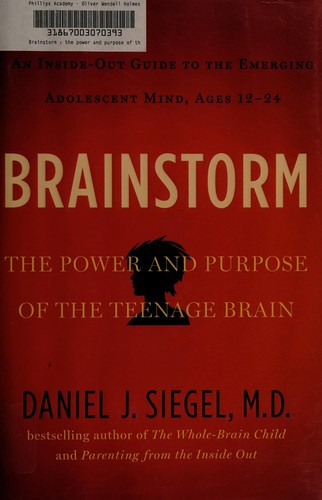
Brainstorm
0
0
As an Amazon Associate and affiliate partner, Menrva Books earns from qualifying purchases. Learn more
Author Description
Between the ages of 12 and 24, the brain changes in important, and oftentimes maddening and challenging ways. In this book, the author, a psychiatrist busts a number of commonly held myths about adolescence. He shows that, if parents and teens can work together to form a deeper understanding of the brain science behind all the tumult, they will be able to turn conflict into connection and form a deeper understanding of one another. According to the author, during adolescence we learn important skills, such as how to leave home and enter the larger world, how to connect deeply with others, and how to safely experiment and take risks, thereby creating strategies for dealing with the world's increasingly complex problems. Here he presents an inside-out approach to focusing on how brain development affects our behavior and relationships. Drawing on important new research in the field of interpersonal neurobiology, he explores exciting ways in which understanding how the brain functions can improve the lives of adolescents, making their relationships more fulfilling and less lonely and distressing on both sides of the generational divide.
Menrva's Summary
THE THESIS
This book explores the transformative and often tumultuous period of adolescence by examining the science of brain development. Daniel J. Siegel, a psychiatrist, debunks common myths about teenagers and offers a framework for parents and adolescents to navigate this critical decade. By understanding the neurobiological changes occurring between ages 12 and 24, the book aims to foster deeper connections and understanding across generations. It presents an inside-out approach, focusing on how brain development influences behavior and relationships, ultimately promoting more fulfilling connections and reducing distress.
THE SCOPE MAP
- An examination of brain development during adolescence (ages 12-24).
- Debunking of common myths surrounding teenage behavior.
- An 'inside-out' approach to understanding adolescent behavior and relationships.
- Application of interpersonal neurobiology research to adolescent life.
- Strategies for parents and teens to improve understanding and connection.
- Insights into how adolescents develop skills for independence, connection, and risk-taking.
- Guidance on navigating generational divides through scientific understanding.
THE AUTHORITY PERSPECTIVE
This book is regarded as a valuable resource for parents and educators seeking to understand adolescent brain development. It is praised for its ability to translate complex neuroscience into accessible insights, offering practical guidance for fostering stronger family relationships. The author's approach is noted for its potential to transform conflict into connection by providing a scientific basis for adolescent behavior. The work is seen as a helpful tool for both adolescents and adults navigating the challenges and opportunities of the teenage years.
Page Count:
321
Publication Date:
2013-01-01
ISBN-10:
158542935X
ISBN-13:
9781585429356
Non-Fiction
Fiction
Psychology
Self-help
Parenting
Adolescence
Neuroscience
Community Tags
Similar Books