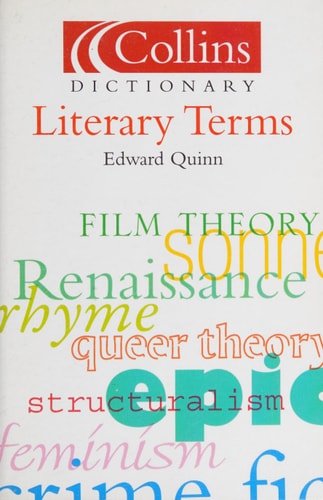
Literary Terms
0
0
As an Amazon Associate and affiliate partner, Menrva Books earns from qualifying purchases. Learn more
Author Description
A complete and authoritative guide to literary terms. From crime fiction to structuralism, from Imagism to queer theory, and from the basics of rhyme to the wilder shores of literary theory, the Collins Dictionary of Literary Terms covers all the bases of modern literary theory. Though designed primarily for students of literary theory, the book will also be of immense use to students in other disciplines, from film theory to philosophy, as well as for the general reader. In a clear, succinct, nontechnical language, this new dictionary of more than 1000 literary terms and themes takes an expanded view of the term `literary'. It is the first book of its kind to give students and general readers not only a traditional literary vocabulary but also the knowledge of related theoretical, historical, and cultural terms they need in the interdisciplinary world of contemporary literary studies. Entries reflect literature as it is taught and experienced today, with increasingly flexible boundaries between high and popular culture, canonical and non-canonical literature, literary and nonliterary vocabulary. Features include:* Concise definitions of literary terms * Major contemporary theoretical terms, with clear definitions and examples * Terms related to Third World and feminist literature * Essays on major themes in literature. * Terms from film, television, psychology, history, and other fields that touch peripherally on literature * References for further reading * Extensive cross-references
Menrva's Summary
THE THESIS
This reference work serves as a comprehensive, interdisciplinary lexicon designed to bridge the gap between traditional literary vocabulary and the evolving landscape of contemporary critical theory. Professor Edward Quinn provides a structured resource that synthesizes over 1,000 terms, catering to students and general readers who require clarity on concepts ranging from classical rhetoric to modern cultural studies. By integrating terminology from film, psychology, and history, the text reflects the current academic shift toward a more fluid, inclusive definition of literary analysis.
THE SCOPE MAP
What You Will Find
- Definitions for over 1,000 literary, theoretical, and cultural terms.
- Specialized entries covering feminist, post-colonial, and structuralist frameworks.
- Essays exploring major thematic currents in literature and their historical context.
- Extensive cross-references and bibliographic pointers for further academic inquiry.
THE AUTHORITY PERSPECTIVE
The text is regarded as a highly accessible and versatile tool for students navigating the complexities of modern interdisciplinary studies. Its focus on clear, nontechnical language makes it a reliable resource for both undergraduates and general readers seeking to decode contemporary critical discourse.
Page Count:
384
Publication Date:
2004-01-01
Publisher:
Harpercollins Pub Ltd
ISBN-10:
0007165552
ISBN-13:
9780007165551
Criticism
Education
Reference
Language Arts
Literature
Literary Form
Academic
Literary Criticism
Community Tags
Similar Books