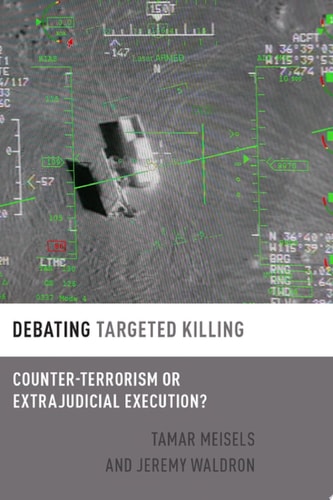
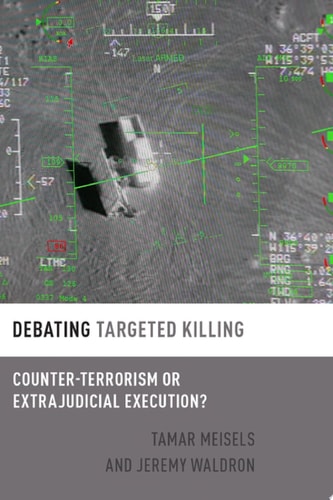
Debating Targeted Killing: Counter-Terrorism or Extrajudicial Execution?
0
0
As an Amazon Associate and affiliate partner, Menrva Books earns from qualifying purchases. Learn more
Author Description
Known terrorists are often targeted for death by the governments of Israel and the United States. Several thousand have been killed by drones or by operatives on the ground in the last twenty years. Is this form of killing justified, when hundreds or thousands of lives are possibly at risk at the hands of a known terrorist? Is there anything about it that should disturb us? Ethically-sound and practical answers to these questions are more difficult to come by than it might seem. Renowned political theorists Jeremy Waldron and Tamar Meisels here defend two competing positions on the legitimacy of targeted killing as used in counterterrorism strategy in this riveting and essential for-and-against book. The volume begins with a joint introduction, briefly setting out the terms of discussion, and presenting a short historical overview of the practice: what targeted killing is, and how it has been used in which conflicts and by whom. It then hones in on killings themselves and the element of targeting. The authors tackle difficult and infinitely complex subjects, for example the similarities and differences between targeted killing of terrorists and ordinary killings in combat, and they ask whether targeted killing can be regarded as a law enforcement strategy, or as a hybrid between combat and law enforcement. They compare the practice of targeted killing with assassination and the use of death squads. And they consider the likelihood that targeted killing has been or will be abused against insurgents, criminals, or political opponents. Meisels analyzes the assassination by Israeli operatives of nuclear scientists working for regimes hostile to Israel. Meisels and Waldron carefully consider whether this sort of killing can ever be justified in terms of the danger it, in theory, averts. The conclusions drawn are at once as surprising as they are insightful, cautioning us against a world in which targeted killing is the norm as it proliferates rapidly.
Menrva's Summary
THE THESIS
This work investigates the moral and legal legitimacy of targeted killing as a counter-terrorism strategy employed by modern states. Political theorists Jeremy Waldron and Tamar Meisels utilize their expertise in legal philosophy and political ethics to present a structured debate on the practice. By examining the intersection of combat operations and law enforcement, the authors evaluate whether the preemptive elimination of individuals can be justified within the framework of international norms and state security.
THE SCOPE MAP
What You Will Find
- A historical overview of targeted killing practices in modern conflicts
- Comparative analysis between targeted killing, assassination, and death squads
- Ethical frameworks for evaluating the risks of state abuse against political opponents
- Case studies regarding the targeting of nuclear scientists and insurgents
Scope Limits
- The text does not provide a comprehensive legal manual for military operations
- It does not offer a definitive policy recommendation for specific government agencies
THE AUTHORITY PERSPECTIVE
Experts recognize this volume as a significant contribution to the ethics of modern warfare, noting the clarity with which the authors navigate complex legal distinctions. Readers frequently highlight the balanced approach of the for-and-against format, which provides a rigorous intellectual foundation for understanding the implications of drone warfare and state-sanctioned lethal force.
Page Count:
321
Publication Date:
2020-01-01
Publisher:
Oxford University Press
ISBN-10:
0190906944
ISBN-13:
9780190906948
Philosophy
Law
International relations
Ethics
Military Strategy
Counter Terrorism
Community Tags
Similar Books







Reader Comments
Share Your Thoughts
No comments yet. Be the first to share your thoughts!