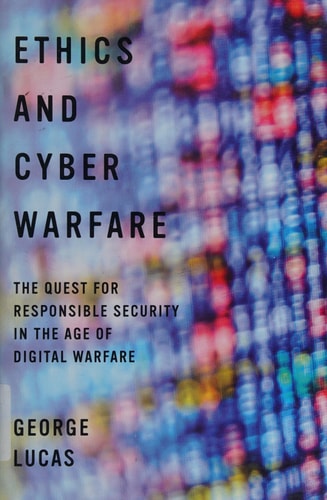
Ethics and Cyber Warfare: The Quest for Responsible Security in the Age of Digital Warfare
0
0
As an Amazon Associate and affiliate partner, Menrva Books earns from qualifying purchases. Learn more
Author Description
From North Korea's recent attacks on Sony to perpetual news reports of successful hackings and criminal theft, cyber conflict has emerged as a major topic of public concern. Yet even as attacks on military, civilian, and commercial targets have escalated, there is not yet a clear set of ethical guidelines that apply to cyber warfare. Indeed, like terrorism, cyber warfare is commonly believed to be a war without rules. Given the prevalence cyber warfare, developing a practical moral code for this new form of conflict is more important than ever.In Ethics and Cyber Warfare, internationally-respected ethicist George Lucas delves into the confounding realm of cyber conflict. Comparing "state-sponsored hacktivism" to the transformative impact of "irregular warfare" in conventional armed conflict, Lucas offers a critique of legal approaches to governance, and outlines a new approach to ethics and "just war" reasoning. Lucas draws upon the political philosophies of Alasdair MacIntyre, John Rawls, and Jürgen Habermas to provide a framework for understanding these newly-emerging standards for cyber conflict, and ultimately presents a professional code of ethics for a new generation of "cyber warriors."Lucas concludes with a discussion of whether preemptive self-defense efforts - such as the massive government surveillance programs revealed by Edward Snowden - can ever be justified, addressing controversial topics such as privacy, anonymity, and public trust. Well-reasoned and timely, Ethics and Cyber Warfare is a must-read for anyone with an interest in philosophy, ethics, or cybercrime.
Menrva's Summary
THE THESIS
This book investigates the absence of established ethical frameworks governing cyber conflict and proposes a moral code for the digital age. George R. Lucas, an internationally recognized ethicist, utilizes traditional just war theory and political philosophy to address the unique challenges posed by state-sponsored hacktivism and irregular digital warfare. By synthesizing the works of thinkers such as Alasdair MacIntyre, John Rawls, and Jürgen Habermas, the author constructs a normative framework designed to guide the conduct of cyber warriors and policymakers alike.
THE SCOPE MAP
What You Will Find
- Analysis of state-sponsored hacktivism compared to irregular warfare
- Application of just war theory to digital conflict
- Ethical evaluation of government surveillance and preemptive self-defense
- Philosophical frameworks derived from MacIntyre, Rawls, and Habermas
Scope Limits
- Does not provide technical instructions for cybersecurity defense
- Does not offer a comprehensive legal history of every specific cyber attack
THE AUTHORITY PERSPECTIVE
Experts recognize this work as a significant contribution to the intersection of military ethics and emerging technology. Readers frequently note the academic density of the prose, which effectively bridges the gap between abstract political philosophy and the practical realities of modern cyber conflict.
Page Count:
208
Publication Date:
2016-12-13
Publisher:
Oxford University Press
ISBN-10:
0190276525
ISBN-13:
9780190276522
Philosophy
Technology
National security
Political Philosophy
International relations
Cyber Warfare
Just war
Ethics
Computer Crimes
Military Strategy
Community Tags
Similar Books