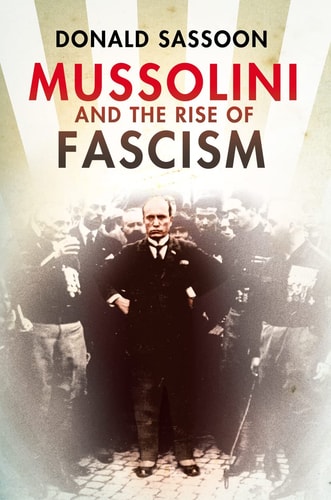
Mussolini and the Rise of Fascism
0
0
As an Amazon Associate and affiliate partner, Menrva Books earns from qualifying purchases. Learn more
Author Description
On the morning of October 30, 1922, Mussolini arrived in Rome to accept the premiership of a constitutional, conservative government. Within five years, however, his regime would morph into a dictatorship that neither his fascist supporters nor the conservative old order could have predicted, and Mussolini himself would be transformed from figurehead to despot. A multiplicity of personalities and wider impersonal forces, including the social upheaval caused by the previous world war, combined to make possible the crisis of 1922 and the Fascist March on Rome. But in fact, Donald Sassoon argues, things could have gone very differently, and the core focus of this illuminating study is not so much what happened, but how. How did Mussolini seize power so effectively that he maintained it for the next 20 years, until he dragged his country, disastrously, into World War II? Social fragmentation, unionization, inflation, and nationalism all played a part in weakening the old political system, while Mussolini seemed to provide answers in a troubling new era. Il Duce's ruthless political ambition and cruel authoritarianism would surprise his supporters and opponents alike.
Menrva's Summary
THE THESIS
This study investigates the specific political mechanisms and social conditions that enabled Benito Mussolini to transition from a constitutional premier to a long-term authoritarian dictator. Donald Sassoon, a historian of modern Europe, utilizes a framework that balances individual political agency against the broader socio-economic instability of post-World War I Italy. By examining the collapse of the conservative old order, the author argues that the rise of fascism was not an inevitable historical outcome but the result of specific, avoidable political failures and strategic maneuvers.
THE SCOPE MAP
What You Will Find
- Analysis of the social fragmentation, inflation, and unionization that destabilized post-war Italy.
- Examination of the political maneuvering surrounding the 1922 March on Rome.
- Evaluation of the role of nationalism in weakening established democratic institutions.
- Assessment of the transformation of Mussolini from a figurehead into a twenty-year despot.
THE AUTHORITY PERSPECTIVE
This work provides a focused, analytical examination of the mechanics of power consolidation in early twentieth-century Italy. The text is suited for readers seeking a detailed historical account of how democratic systems can be dismantled through political opportunism and social crisis.
Page Count:
224
Publication Date:
2008-01-01
Publisher:
HarperCollins UK
ISBN-10:
0007192428
ISBN-13:
9780007192427
Biography
History
Fascism italy
European History
Fascism
Italy history
Community Tags
Similar Books