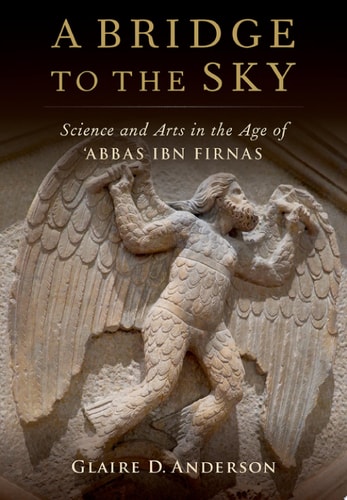
A Bridge to the Sky: The Arts of Science in the Age of 'Abbas Ibn Firnas
0
0
As an Amazon Associate and affiliate partner, Menrva Books earns from qualifying purchases. Learn more
Author Description
In times of widespread Islamophobia, there is an understandable motivation for constructing scientific achievement as a counternarrative in popular discourse about Islam. Yet doing so has tended to impose an anachronistic conception of "science" onto pre-modern practices while also obscuring wider views of the intellectual, philosophical, and particularly the material context of medieval scientific achievement. An exemplary case study for this phenomenon is the figure of 'Abbas Ibn Firnas (d. 887), a celebrated early scientist, Córdoban courtier, and polymath. Ibn Firnas is best known today for conducting an early aeronautics experiment, which was commemorated by NASA. Some historians have called it the first successful human flight. The earliest and fullest account of Ibn Firnas' career in the Umayyad court includes the aeronautics experiment, and a great deal more on his achievements in the arts and design but has yet to receive sustained scholarly attention. That account, as preserved in a volume of the Muqtabas of Ibn Hayyan (d. 1076), the Cordoban court chronicle, presents Ibn Firnas as both the leading intellectual of early Islamic Iberia and as a pioneering figure in the design and construction of the court's first fine scientific instruments and space of scientific visualization.A Bridge to the Sky reconstructs the account of Ibn Firnas' career to explore the exact sciences, design, and making as interconnected intellectual practices during the first flowering of the Islamic scientific revolution. Glaire D. Anderson deftly weaves analyses of the Arabic texts alongside the striking contemporaneous visual evidence, including some of the earliest surviving Islamic scientific instruments and illustrated treatises that are, as argued here, also works of art. A Bridge to the Sky thus offers both an intellectual biography of the intriguing figure of Ibn Firnas alongside an exploration of the culture of scientific learning in Umayyad al-Andalus.
Menrva's Summary
THE THESIS
How did the intellectual, philosophical, and material contexts of Umayyad al-Andalus shape the scientific and artistic contributions of the polymath 'Abbas Ibn Firnas? Glaire D. Anderson, an expert in Islamic art and architecture, challenges the modern tendency to project contemporary definitions of science onto pre-modern figures. By analyzing the court chronicle of Ibn Hayyan, she argues that the exact sciences, design, and material production were deeply interconnected practices during the early Islamic scientific revolution.
THE SCOPE MAP
What You Will Find
- Analysis of the Muqtabas of Ibn Hayyan regarding the career of 'Abbas Ibn Firnas.
- Examination of early Islamic scientific instruments as both functional tools and works of art.
- Investigation into the court culture of Umayyad al-Andalus and its role in scientific visualization.
Scope Limits
- The text does not provide a general history of Islamic science beyond the specific context of the Umayyad court in Iberia.
- It does not attempt to validate or debunk modern claims of aeronautical success, focusing instead on the historical record and material culture.
THE AUTHORITY PERSPECTIVE
Scholars recognize this work as a significant intervention in the study of medieval Islamic intellectual history by bridging the gap between art history and the history of science. Readers frequently note the author's meticulous use of primary Arabic texts and material evidence to reconstruct the professional life of a historically elusive figure.
Page Count:
248
Publication Date:
2024-01-01
Publisher:
Oxford University Press
ISBN-10:
019091324X
ISBN-13:
9780190913243
History
Biography
Science History
Europe
Technology history
Art History
Reference
Schools & Teaching
Historical
Islamic Studies
Engineering
Technology
Community Tags
Similar Books