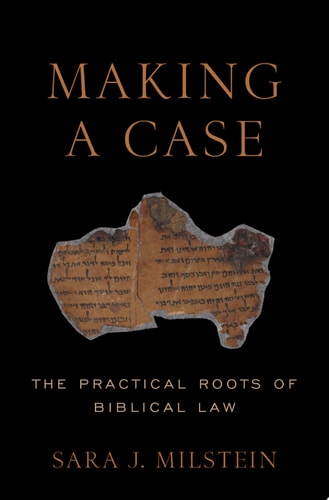
Making a Case: The Practical Roots of Biblical Law
0
0
As an Amazon Associate and affiliate partner, Menrva Books earns from qualifying purchases. Learn more
Author Description
Outside of the Bible, all of the known Near Eastern law collections were produced in the third to second millennia BCE, in cuneiform on clay tablets, and in major cities in Mesopotamia and in the Hittite Empire. None of the major sites in Syria that have yielded cuneiform tablets has borne even a fragment of a law collection, even though several have produced ample legal documentation. Excavations at Nuzi have also turned up numerous legal documents, but again, no law collection. Even Egypt has not yielded a collection of laws. As such, the biblical texts that scholars regularly identify as law collections represent the only "western," non-cuneiform expressions of the genre in the ancient Near East, produced by societies not known for their political clout, and separated in time from "other" collections by centuries. Making a Case: The Practical Roots of Biblical Law challenges the long-held notion that Israelite and Judahite scribes either made use of "old" law collections or set out to produce law collections in the Near Eastern sense of the genre. Instead, what we call "biblical law" is closer in form and function to another, oft-neglected Mesopotamian genre: legal-pedagogical texts. During their education, Mesopotamian scribes studied a variety of legal-oriented school texts, including sample contracts, fictional cases, short sequences of laws, and legal phrasebooks. When biblical law is viewed in the context of these legal-pedagogical texts from Mesopotamia, its practical roots in a set of comparable legal exercises begin to emerge.
Menrva's Summary
THE THESIS
This book investigates the origins of biblical law by challenging the traditional view that Israelite and Judahite scribes were attempting to create formal law collections similar to those found in Mesopotamia. Sara J. Milstein, a scholar of ancient Near Eastern texts, argues that biblical law is better understood as a form of legal-pedagogical literature. By comparing biblical texts to Mesopotamian school exercises, she posits that these writings functioned as practical educational tools rather than as state-sanctioned legal codes.
THE SCOPE MAP
What You Will Find
- Comparative analysis of biblical legal texts and Mesopotamian school curricula
- Examination of legal-pedagogical genres including sample contracts and phrasebooks
- Historical context regarding the absence of law collections in Syria and Egypt
Scope Limits
- The study does not provide a comprehensive history of all ancient Near Eastern legal systems
- It does not focus on the theological implications of biblical law, prioritizing form and function over religious doctrine
THE AUTHORITY PERSPECTIVE
Scholars recognize this work as a significant contribution to the field of biblical studies for its focus on scribal education and genre classification. Readers frequently note the academic density of the prose, which requires a foundational understanding of ancient Near Eastern history to fully appreciate the author's methodology.
Page Count:
214
Publication Date:
2021-01-01
Publisher:
Oxford University Press
ISBN-10:
0190911824
ISBN-13:
9780190911829
History
Religion
Judaism
Bibles
Near East
Archaeology
World Religions
Legal History
Community Tags
Similar Books