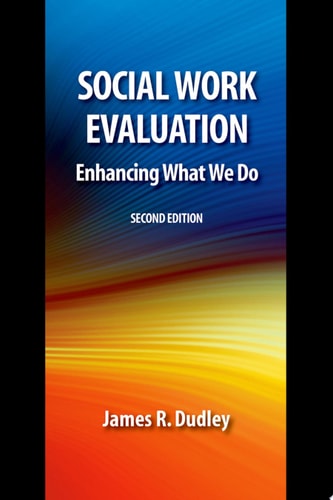
Social Work Evaluation: Enhancing What We Do
0
0
As an Amazon Associate and affiliate partner, Menrva Books earns from qualifying purchases. Learn more
Author Description
Social workers are increasingly faced with the demands of evaluating their own programs and practice to maintain accountability to funding agencies, secure funding, and remedy a number of social problems facing our society. One of the nine basic competencies required by the social work accreditation agency is to be able to conduct evaluations. Evaluation is a critical area of practice for demonstrating accountability to clients, communities, numerous other stakeholders, and funding and regulatory agencies. Social Work Evaluation, Third Edition, offers a straightforward guide to a broad range of social work evaluations at both the program and practice levels. Author James R. Dudley's seven-step approach to evaluation makes use of qualitative, quantitative, and mixed research methods to provide oversight and address important issues at the planning, implementation, and outcome stages of a program or practice intervention. His unique focus on involving clients in the evaluation process ensures that social workers consistently improve their capacity to impact their clients' well-being and remain accountable to them and others they serve. Case examples from the extensive evaluation experience of the author and others illustrate a wide range of logic-based methods discussed throughout the text for real-world application. This comprehensive text effectively aims to enhance student and practitioner skill sets to meet these demands of a changing field.
Menrva's Summary
THE THESIS
How can social workers effectively evaluate their own programs and practices to meet professional accountability standards while simultaneously improving client outcomes? James R. Dudley, an experienced practitioner and educator, provides a structured framework designed to integrate evaluation into daily social work practice. By utilizing a seven-step methodology, the text argues that rigorous evaluation is not merely an administrative burden but a vital tool for demonstrating efficacy to stakeholders and funding agencies.
THE SCOPE MAP
What You Will Find
- A seven-step approach to evaluation covering planning, implementation, and outcome stages.
- Integration of qualitative, quantitative, and mixed research methodologies.
- Practical case examples derived from real-world social work interventions.
- Strategies for involving clients directly in the evaluation process to ensure service improvement.
Scope Limits
- The text focuses primarily on social work practice and program evaluation rather than broad sociological theory.
- It does not cover advanced statistical software training or complex econometric modeling.
THE AUTHORITY PERSPECTIVE
Practitioners and students frequently identify this text as a practical, accessible resource for meeting accreditation competencies. Experts highlight the author's emphasis on client-centered evaluation as a distinguishing feature that bridges the gap between academic research and field application.
Page Count:
362
Publication Date:
2020-01-01
Publisher:
Oxford University Press
ISBN-10:
0190916672
ISBN-13:
9780190916671
Education
Social service
Introduction to Social WorkWelfare
Professional Development
Social Action
Human services
Social Work
Research Methods