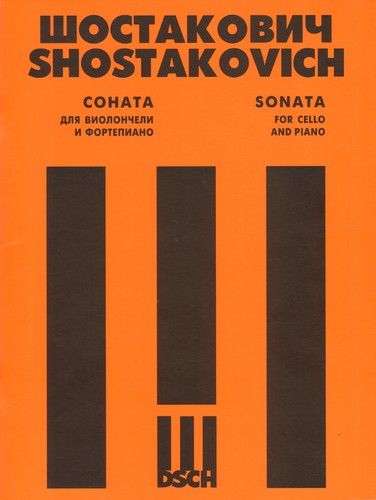
Sonata for Cello and Piano, op. 40
0
0
As an Amazon Associate and affiliate partner, Menrva Books earns from qualifying purchases. Learn more
Author Description
On the way to premiere his Sonata for Cello and Piano, Op. 40, (1934), Shostakovich reportedly first read Stalin's statement in Pravda attacking his music as "bourgeois." Indeed, the period that was to follow was a trying one for the composer, culminating in the execution of one of his most ardent supporters in the Soviet government and the withdrawal of several of his works from rehearsal and performance. The sonata, however, did not raise the ire of the state, though not because it lacked Shostakovich's characteristically problematic sarcasm. It is written very much in the style of the composer's large-scale symphonic works: four movements rife with cynicism, despair, and mockery. The opening movement is in a conventional sonata form, complete with a repeating exposition built around two resignedly lyrical themes. The main theme never truly recapitulates, though it reappears in sluggish mode following a restatement of the second subject, bringing the movement to a haunting, mysterious close. The tactless Scherzo opens with coarse, repetitive sawing from the cello, over which the piano plays a rather heavy-handed melody in which the composer irreverently bites his thumb at those who would make his music more "accessible." The ornamented, aria-like third movement juxtaposes slow, dragging despair with passionate hope before dying away into a heavy silence. The rude, comically sinister finale, which builds tremendous momentum only to come to an abrupt and unceremonious end, effectively snubs those looking forward to a showy, brilliant finish. - Graham Olson at allmusic.com
Menrva's Summary
THE THESIS
The Sonata for Cello and Piano, Op. 40, composed in 1934, navigates a period of intense political pressure on Dmitri Shostakovich. Despite the surrounding climate of state censorship and persecution, which saw supporters executed and works withdrawn, this sonata, while retaining the composer's characteristic sarcasm and cynicism, did not draw the ire of the Soviet regime. It is structured in four movements, reflecting the scale and complexity of his symphonic works, and is imbued with themes of despair, mockery, and a defiant spirit.
THE SCOPE MAP
- The first movement is in a conventional sonata form, featuring a repeating exposition with two lyrical themes, though the main theme's true recapitulation is notably absent, leading to a haunting conclusion.
- The Scherzo is characterized by a tactless opening with prominent cello sawing, accompanied by a heavy-handed piano melody that suggests irreverent defiance.
- The third movement is an ornamented, aria-like section that contrasts slow despair with passionate hope, ultimately fading into silence.
- The finale is described as rude and comically sinister, building momentum only to conclude abruptly and unceremoniously, subverting expectations of a brilliant finish.
THE AUTHORITY PERSPECTIVE
The reception of Shostakovich's Sonata for Cello and Piano, Op. 40, as described by Graham Olson at allmusic.com, highlights its complex relationship with the political climate of its creation. The piece is noted for embodying the composer's characteristic sarcasm, cynicism, and despair, even as it avoided direct condemnation from the Soviet state. Its structure and thematic development, particularly the unconventional recapitulation in the first movement and the abrupt finale, are seen as integral to its expressive power. The sonata is understood as a work that, while not overtly challenging the authorities, still contains the composer's defiant spirit and complex emotional landscape.
Page Count:
0
Publication Date:
2016-01-01
ISBN-13:
9790706427133
Music
Piano Music
Chamber Music
Sheet Music
Cello Music
Community Tags
Similar Books