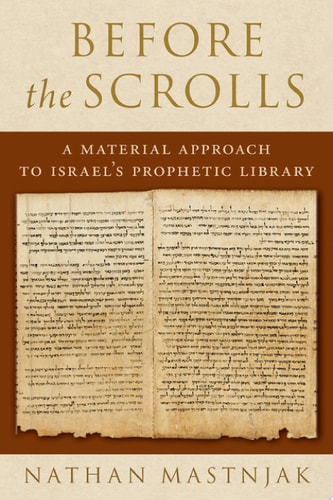
Before the Scrolls: A Material Approach to Israel's Prophetic Library
0
0
As an Amazon Associate and affiliate partner, Menrva Books earns from qualifying purchases. Learn more
Author Description
Before the Scrolls traces the media history of the biblical prophetic corpus to propose a material approach to biblical literature. Although scholars understand that the material of composition was the scroll rather than the codex, they persist in imagining the form as a single textual object. This assumption pervades centuries of scholarship and drives many of the questions asked about biblical composition. Nathan Mastnjak raises the question of the original physical format of biblical texts and argues that many of the literary works that would eventually become the Bible's prophetic books were not written initially as books. Isaiah, Jeremiah, and Ezekiel were originally composed on loosely organized collections of multiple short papyrus scrolls and sheets. Though rarely considered in scholarship, the realia of a text's form, format, production, and material substance have a profound influence on the meaning of the text. Unlike works committed to single book-scrolls, these collections did not have predetermined orders of reading and were susceptible to multiple arrangements. Only in the Hellenistic era were these compositions edited, organized, and copied into single volume book-scrolls such as those known from the Dead Sea.By investigating the relationship between form and meaning and the transition from the collection to the book, Mastnjak suggests novel solutions to classic problems in biblical scholarship, such as the relationships between the MT and LXX of Jeremiah and that between First and Second Isaiah. The failure to account for the materiality of the prophetic corpus has led scholarship to occasionally ask the wrong questions of these compositions and has blinded it to the vital role that Hellenistic bookmakers played in the creation of the Bible as we know it. Reconceiving much Judean literature on a collection-model rather than book-model has significant implications for our understanding of how the Bible itself was composed and read.
Menrva's Summary
THE THESIS
This work investigates how the physical materiality of ancient prophetic texts—specifically their original format as collections of small papyrus scrolls rather than single volumes—fundamentally shaped their composition and subsequent interpretation. Nathan Mastnjak, a scholar in biblical studies, challenges the long-standing academic assumption that prophetic books were conceived as unified textual objects from their inception. By analyzing the transition from loose collections to standardized book-scrolls in the Hellenistic era, he provides a new framework for understanding the structural inconsistencies and textual variations found in the Hebrew Bible.
THE SCOPE MAP
What You Will Find
- Analysis of the media history of the biblical prophetic corpus.
- A material-based methodology for evaluating biblical composition.
- Comparative study of the Masoretic Text (MT) and the Septuagint (LXX) regarding Jeremiah and Isaiah.
- Examination of Hellenistic bookmaking practices and their influence on biblical canonization.
Scope Limits
- The study focuses primarily on the prophetic corpus and does not provide an exhaustive analysis of the entire Hebrew Bible.
- It does not attempt to reconstruct the specific content of lost papyrus sheets but rather focuses on the implications of their physical format.
THE AUTHORITY PERSPECTIVE
Scholars in the field of biblical criticism identify this text as a significant intervention in the study of ancient media and textual transmission. Readers frequently note the academic density of the prose, which is intended for specialists and advanced students of biblical history.
Page Count:
264
Publication Date:
2023-01-01
Publisher:
Oxford University Press
ISBN-10:
0190911093
ISBN-13:
9780190911096
History
Archaeology
Literary Criticism
Near East
Theology
Bible
Community Tags
Similar Books