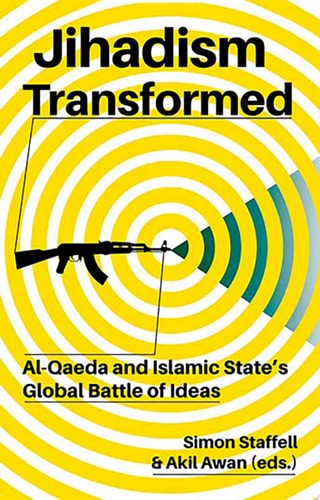
Jihadism Transformed
0
0
As an Amazon Associate and affiliate partner, Menrva Books earns from qualifying purchases. Learn more
Author Description
Jihadist narratives have evolved dramatically over the past five years, driven by momentous events in the Middle East and beyond; the death of Bin Laden; the rise and ultimate failure of the Arab Spring; and most notably, the rise of the so-called Islamic State. For many years, Al-Qaeda pointed to an aspirational future caliphate as their utopian end goal - one which allowed them to justify their violent excesses in the here and now. Islamic State turned that aspiration into a dystopic reality, and in the process hijacked the jihadist narrative, breathing new life into the global Salafi-jihadi movement. Despite air-strikes from above, and local disillusionment from below, the new caliphate has stubbornly persisted and has been at the heart of ISIS's growing global appeal. This timely collection of essays examines how jihadist narratives have changed globally, adapting to these turbulent circumstances. Area and thematic specialists consider transitions inside the Middle East and North Africa as well as in South Asia, Sub-Saharan Africa and Europe. As these analyses demonstrate, the success of the ISIS narrative has been as much about resonance with local contexts, as it has been about the appeal of the global idea of a tangible and realised caliphate.
Menrva's Summary
THE THESIS
This collection of essays investigates how the ideological narratives of jihadist movements have shifted in response to the rise and subsequent challenges of the Islamic State. The authors, Akil Awan and Simon Staffell, curate contributions from regional and thematic specialists to analyze the transition from Al-Qaeda's aspirational caliphate to the tangible, albeit dystopic, reality established by ISIS. The text argues that the movement's persistence is rooted in its ability to adapt its messaging to resonate with specific local contexts while maintaining the global appeal of a realized caliphate.
THE SCOPE MAP
What You Will Find
- Analysis of jihadist narrative evolution post-Arab Spring
- Regional case studies covering the Middle East, North Africa, South Asia, Sub-Saharan Africa, and Europe
- Examination of the interplay between global ideological goals and local socio-political conditions
Scope Limits
- The text does not provide a comprehensive military history of the conflict
- It does not focus on tactical counter-terrorism operations, prioritizing ideological and narrative analysis instead
THE AUTHORITY PERSPECTIVE
Experts identify this work as a significant contribution to the study of extremist rhetoric and the adaptation of non-state actor ideologies. Readers frequently note the academic density of the prose, which provides a rigorous framework for understanding the shifting landscape of global jihadism.
Page Count:
0
Publication Date:
2016-01-01
Publisher:
Oxford University Press
ISBN-10:
0190911255
ISBN-13:
9780190911256
History
Sociology
International relations
Middle Eastern
Community Tags
Similar Books