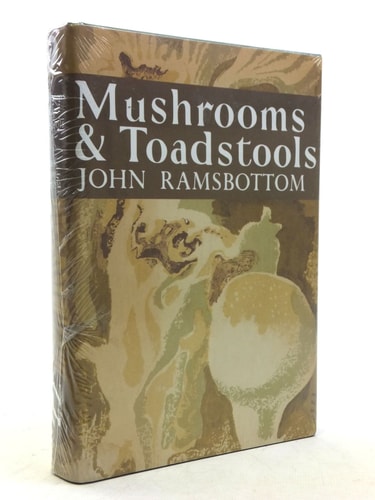
Mushrooms and Toadstools
0
0
As an Amazon Associate and affiliate partner, Menrva Books earns from qualifying purchases. Learn more
Author Description
Britain's neglect of fungi as table delicacies has perhaps been responsible for our surprising ignorance of the natural history of such fascinating plants. Puff-balls, more than a foot in diameter; mouls in jam-pots; dry rot; truffles; these are examples of the wide range of the Group, comprising over 100,000 species.Many are of economic importance - for example, the rusts that attack wheat and other crops, and the yeasts which ferment beer - and there are others of great biological interest, such as the mycorrhizal fungi which live in association with the roots of forest trees, orchids and other plants, and help them to absorp food from the soil. Penicillin, of course, has become a household word, and this book's final chapter on the industry is one of the best short accounts of the subject yet writtern.Dr. Ramsbottom was for many years Keeper of Botany at the Natural History Museum, and has devoted his life to the study of fungi in all their aspects. He is equally at home in the field, the laboratory and the library. One of the special features of Mushrooms and Toadstools is the wealth of historical allusion to fungi extracted from old books.Set out in a style reminiscent of Robert Burton, this colume can truly be described as a 20th century "Anatomy of Toadstool." Indeed, in fairy rings, science and superstition have gone hand in hand to produce a lively story of alternating surmise and research - and even today a full and final explanation of these mysterious rings has not yet been made.Many of the larger toadstools are brightly coloured and lend themselves admirably to colour photography, as shown by the 80 remarkable illustrations by Mr Paul de Laszlo.
Menrva's Summary
THE THESIS
This work investigates the biological, historical, and economic significance of fungi, addressing the paradox of why such a diverse and essential group of organisms remains largely misunderstood by the general public. Dr. John Ramsbottom, a former Keeper of Botany at the Natural History Museum, utilizes his extensive field and laboratory experience to synthesize a comprehensive overview of fungal life. The text balances scientific inquiry with historical context, examining everything from the destructive impact of rusts on agriculture to the medical breakthroughs provided by penicillin. By bridging the gap between folklore and modern research, the author provides a foundational framework for understanding the complex roles fungi play in ecosystems and human industry.
THE SCOPE MAP
What You Will Find
- A broad survey of fungal diversity, covering over 100,000 species including puff-balls, truffles, and molds.
- Detailed analysis of the economic and biological roles of fungi, such as mycorrhizal associations and fermentation processes.
- Historical perspectives on the study of fungi, incorporating references from classical literature and early scientific texts.
- An examination of the intersection between science and superstition, specifically regarding the formation of fairy rings.
- 80 color photographic illustrations by Paul de Laszlo documenting various species.
THE AUTHORITY PERSPECTIVE
The text is regarded as a classic within the Collins New Naturalist Library, noted for its scholarly depth and accessible, erudite prose style. Its blend of historical anecdote and rigorous botanical observation makes it a significant reference for both amateur naturalists and professional biologists interested in the history of the field.
Page Count:
320
Publication Date:
2008-01-01
Publisher:
Collins with The Folio Society
ISBN-10:
0007278543
ISBN-13:
9780007278541
Nature
Science
Natural History
Botany
Science & Math
Plants
Mycology
Biology
Community Tags
Similar Books