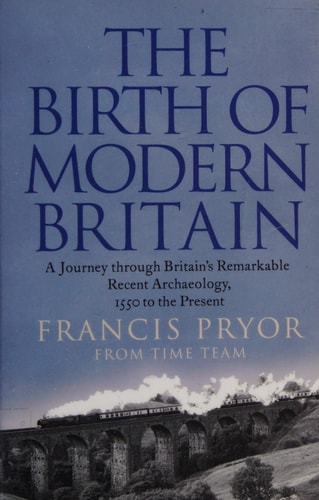
The Birth of Modern Britain: A Journey Through Britain’s Remarkable Recent Archaeology
0
0
As an Amazon Associate and affiliate partner, Menrva Books earns from qualifying purchases. Learn more
Author Description
From the author of ‘Britain BC’, ‘Britain AD’ and ‘Britain in the Middle Ages’ comes the fourth and final part in a critically acclaimed series on Britain's hidden pastThe relevance of archaeology to the study of the ancient world is indisputable. But, when exploring our recent past, does it have any role to play? In ‘The Birth of Modern Britain’ Francis Pryor highlights archaeology’s continued importance to the world around us.The pioneers of the Industrial Revolution were too busy innovating to record what was happening around them but fortunately the buildings and machines they left behind bring the period to life. During the Second World War, the imminent threat of invasion meant that constructing strong defences was much more important than keeping precise records. As a result, when towns were flattened, archaeology provided the only real means of discovering what had been destroyed.Surveying the whole post-medieval period, from 1550 until the present day, Francis Pryor takes us on an exhilarating journey, bringing to a gripping conclusion his illuminating study of Britain’s hidden past.
Menrva's Summary
THE THESIS
Does archaeology retain its utility as a primary investigative tool when applied to the documentation of Britain’s recent, post-medieval history? Francis Pryor, a distinguished archaeologist known for his extensive work on the British landscape, utilizes physical evidence—ranging from industrial machinery to wartime defensive structures—to reconstruct historical narratives where written records are either absent or incomplete. He argues that the material remains of the last five centuries offer a vital, tangible counterpoint to traditional archival history.
THE SCOPE MAP
What You Will Find
- A comprehensive survey of British archaeological sites from 1550 to the present day.
- Analysis of industrial-era architecture and machinery as primary historical documents.
- Examination of wartime defensive fortifications and the archaeological recovery of destroyed urban landscapes.
- A methodological framework for interpreting the recent past through physical remnants rather than solely relying on written accounts.
THE AUTHORITY PERSPECTIVE
This work is regarded as a significant contribution to the field of public archaeology, praised for its ability to bridge the gap between academic research and the tangible history of the modern era. The text is noted for its accessible prose and its success in demonstrating that archaeology is as relevant to the Industrial Revolution as it is to prehistoric studies.
Page Count:
320
Publication Date:
2012-02-02
Publisher:
HarperPress
ISBN-10:
0007299117
ISBN-13:
9780007299119
History
Archaeology
British History
Great Britain
Modern History
Community Tags
Similar Books